
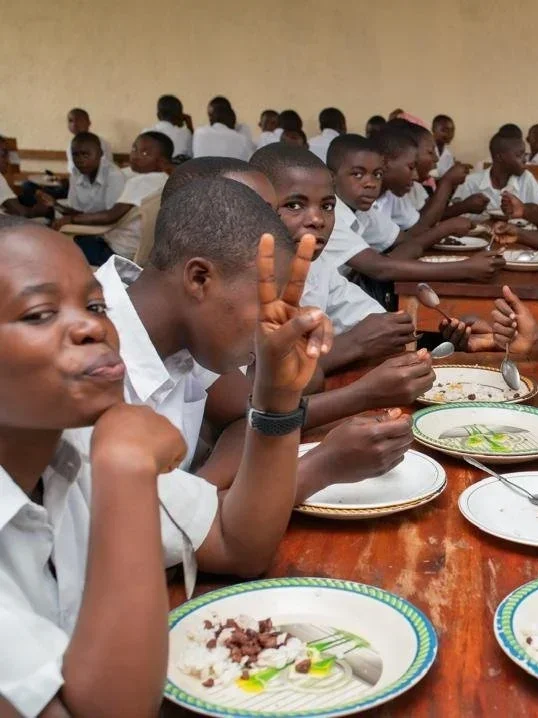
On World Food Day, we recognized the people, resources, and partnerships that keep nutritious meals on the table for children learning amid conflict and displacement.
A school meal doesn't begin when a plate reaches the table.
It takes sourcing food. Water. Cooks. Equipment. Energy. Storage. Transportation. And the resources to keep all of it working every day.
At Congo Peace School in South Kivu, Democratic Republic of Congo, providing meals is much more than a daily kitchen routine.
It's part of creating the conditions children need to learn.
When Hunger Is Part of Everyday Life
Across the Democratic Republic of Congo, conflict and displacement have made access to nutritious food increasingly difficult for millions of families.
According to the Integrated Food Security Phase Classification (IPC), an estimated 26.5 million people—23% of the population analyzed—faced crisis-level or worse acute food insecurity during the January–June 2026 projection period.
More than 9.9 million of those people were in four eastern provinces: North Kivu, South Kivu, Ituri, and Tanganyika.
The crisis isn't somewhere far away from Congo Peace School.
Kabare Territory, where the school is located, was classified as IPC Phase 3 (Crisis) for that same period, reflecting severe food insecurity in the school's immediate community.
Conflict has disrupted agricultural production, transportation routes, local markets, and household incomes. For families already struggling economically, the rising cost and uncertain availability of food create difficult choices.
Against this backdrop, a dependable school meal takes on particular significance.
Two Meals a Day, Every School Day
At Congo Peace School, 755 students receive a light breakfast and a hearty lunch every school day.
That's as many as 1,510 meals prepared and served each day when all enrolled students attend.
Students are admitted according to need rather than their families' ability to pay. Many come from economically vulnerable households, including 193 children displaced by violent conflict. In its 2026 program assessment, the school team estimated that approximately 70% of enrolled students—around 530 children—may be experiencing some degree of food insecurity. While the figure is an estimate informed by regional conditions and the economic vulnerability of the student population, it offers an important indication of why reliable access to food matters so much to the school community.
For children facing displacement and economic hardship, the meals provide a consistent source of nourishment and help ease the financial pressure on families. And for students, those benefits extend into the classroom.
Children need adequate nutrition to support growth, health, concentration, and participation in learning. That's why meals at CPS aren't an optional addition to education. They're part of the school day itself.
The People Behind Every Plate
Providing meals for an entire school requires far more coordination than most of us think about when we sit down to eat. Food must be sourced, purchased, and transported. Ingredients need to be stored safely. Water must be available. Cooking equipment needs fuel and maintenance.
And every school day, the kitchen staff must prepare and serve meals for hundreds of children. Four cooks help make this possible at Congo Peace School. Their work supports a program that operates throughout the academic year, with one meal a day also provided during the summer program.
During the 2026 summer period, the school served approximately 400 meals each day.
Keeping that commitment requires reliable funding for food, kitchen personnel, fuel, supplies, and the infrastructure that supports meal preparation.
When the Need Grows
When Congo Peace School opened in 2018, it welcomed 160 students in grades 1 and 2 primary, and 1 and 2 secondary, creating the path for sustainable growth and students to experience as much of their education rooted in the principles taught at the school. Today, enrollment has grown to 755.
Originally designed to accommodate approximately 560 students, the school has expanded its reach in response to growing needs in the surrounding community. The addition of children displaced by conflict has helped families maintain access to education and daily nutrition during a period of extraordinary uncertainty.
But more students also means more meals.
More ingredients to purchase. More food to prepare. Greater demands on the people, equipment, and resources behind every plate. And those demands are growing in a region where insecurity can disrupt roads, markets, and food supplies with little warning.
The Scale of a Daily Commitment
Consider what two meals a day means for a school serving 755 children. For the planned weekday meal-service period between December 2026 and June 2027, the school anticipates 127 school days. At two meals per student, that represents 254 opportunities for each child to receive a nutritious meal.
Across the full student population, the school is planning for as many as 191,770 meal servings during those seven months alone, assuming full attendance and uninterrupted operations.
That's a planning target, not a count of meals already served. But it illustrates the scale of the work required to sustain something that can appear so simple: a dependable meal at school.
And, as previously noted, each meal depends on more than food, it depends on the cooks, the water, the fuel, the transportation, the purchasing, and the resources that allow a school kitchen to keep operating.
Water Is Part of the Story, Too
In October, damaged community water pipes interrupted running water to Congo Peace School, creating an urgent challenge for the kitchen and the entire campus. The school has seven potable-water storage tanks, each holding 5,000 liters, providing a combined storage capacity of 35,000 liters. These reserves helped support drinking and cooking needs when the running water supply was disrupted.
But stored water could not replace the community infrastructure needed to sustain school operations. Kitchen staff drew from potable-water reserves while the school community worked to manage the wider disruption. Thanks to an extraordinary response from supporters and partners, $35,000 was raised in less than a week to fund emergency repairs to the community water system.
The experience was a powerful reminder that providing a school meal depends on much more than the ingredients on a plate.
Making Every School Day Possible
The feeding program is part of a broader approach to caring for the whole student.
Alongside free education, children have access to learning resources, sports and recreation, and wellbeing services designed to help them continue learning amid difficult circumstances.
Despite the challenges surrounding the school, CPS reports approximately 99% student attendance and retention, and its Class of 2026 achieved a 100% pass rate on national examinations. Those results reflect the collective work of students, teachers, families, and school leadership. They demonstrate the educational continuity that CPS works to sustain through its integrated approach to learning, nutrition, and wellbeing.
For World Food Day, we celebrated not only the meals, but the people and partnerships that make them possible.
The cooks who prepare the food. The staff who coordinate daily operations. The families who trust the school with their children. And the community of supporters who help ensure those plates can continue reaching the table.
Help Keep Meals on the Table
As enrollment has grown, so has the cost of maintaining the school's nutrition program. Your gift to Action Kivu helps sustain the food, kitchen personnel, and operational resources needed to continue providing two meals every school day.
Please consider making a one-time contribution or joining our community of monthly supporters. Sustaining gifts are especially valuable, helping us plan ahead and meet the needs of a growing student population.