
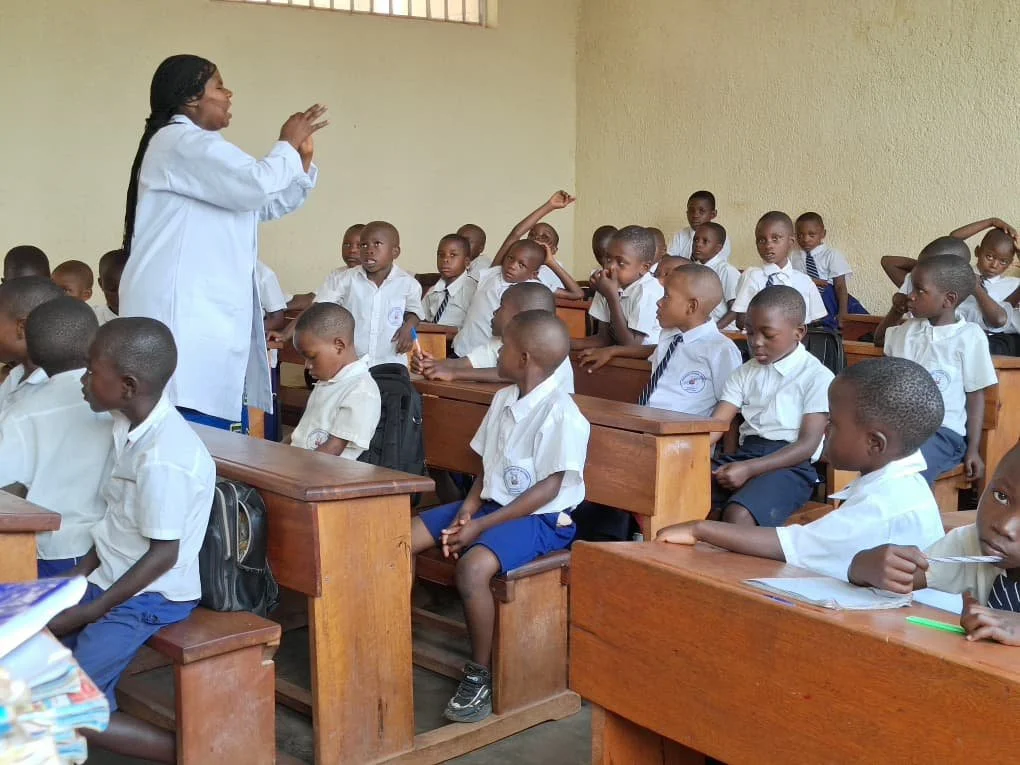
On World Teachers' Day, we honored the educators whose dedication, curiosity, and care make learning possible amid extraordinary challenges.
Elementary school teacher Pascaline stood before her students with a seed.
The lesson was about germination: how a seed absorbs water, how the first root emerges, and how stems and leaves begin to grow.
But the real measure of the lesson wasn't what Pascaline could explain. It was what her students could do with what they had learned.
“The students are learning about the stages of germination. I’ve noticed that they can already plant a seed and explain all these stages to others, starting with the seed, water absorption, the emergence of the root, the stem, and the leaves.”
A small seed. A classroom full of curious children. And the satisfaction of watching students become capable of sharing knowledge themselves.
These everyday moments are at the heart of education at Congo Peace School.
Teaching Through Connection and Respect
In a widely shared 2013 TED Talk, educator Rita Pierson spoke about the importance of meaningful relationships between teachers and students. Her message was simple: children need adults who believe in them and refuse to give up on them.
Amani Matabaro, the Congolese educator and community leader who founded Congo Peace School (CPS), had never heard Pierson's talk when he began developing the school.
Yet the values he brought to the campus reflected a remarkably similar understanding of education.
At CPS, teachers are encouraged to build relationships rooted in dignity, curiosity, and mutual respect. Students are listened to. Mistakes become opportunities to learn. Even teachers can apologize when they get something wrong.
These are more than classroom techniques.
They are part of the school's commitment to nonviolence and peacebuilding, showing children how listening, respect, and cooperation can shape their relationships with others.
Learning to Think, Not Simply Memorize
Merci Methode, a secondary school mathematics teacher, describes the importance of helping students think through problems systematically.
“Students must learn to think critically, analyze problems in a systematic manner, establish relationships between data, and justify their answers, I am very happy and delighted because a large percentage of my students are able to use their mathematical knowledge to solve real-life and practical problems.”
He wants students to understand mathematical concepts, use technical language, and demonstrate how they reach their conclusions. For him, the reward is seeing those skills extend beyond the classroom.
Pascaline's germination lesson and Merci's mathematics classroom share a common goal: helping students develop knowledge they can understand, apply, and share with others.
Keeping Education Possible Amid Conflict
In eastern Congo, the work of teaching extends far beyond the classroom. According to reporting from the DRC Education Cluster in April 2026, which UNICEF and Save the Children co-lead, school closures due to armed conflict left approximately 1.18 million students out of school and affecting 21,895 teachers. Beyond the closures alone, in September 2026 the Education Cluster counted 6,745 schools and more than 2.3 million children directly affected by various incidents across the country. Tens of thousands of teachers were affected.
Some school buildings were damaged. Others were being used to shelter families displaced by violence.
Behind these numbers are children whose lessons were interrupted, friendships scattered, and opportunities to continue their education placed at risk.
Congo Peace School has faced the same regional insecurity, but its local leadership and educators have worked to maintain continuity for students.
When the school opened in 2018, it welcomed 160 children. By September 2026, enrollment had grown to 755, including 193 students displaced by conflict and 82 preschool children.
Originally designed for approximately 560 students, CPS now serves far more children than initially planned.
A team of 56 local teachers and staff helps keep the school functioning, from early childhood education through secondary school.
Their work includes far more than delivering the national curriculum.
Teachers help create a predictable, supportive environment where students can establish routines, build friendships, and continue learning. Staff are trained to recognize signs of trauma and connect students with additional counseling and psychosocial care when needed.
The Results of Showing Up
Despite the extraordinary difficulties surrounding the school, CPS reports approximately 99% attendance and retention.
The Class of 2026 also achieved a 100% pass rate on its national examinations.
These results cannot be credited to any one teacher, program, or intervention. They reflect the combined commitment of students, families, school leadership, educators, and the wider community. They also tell an important story about educational continuity. While conflict has interrupted learning for so many children across the region, CPS teachers have continued helping students move forward and thrive in their education.
A library with more than 3,000 books, a solar-powered computer lab, daily meals, and supportive school services provide resources that help make their work possible.
Behind every result are the everyday acts of teaching: another explanation, another question answered, another student encouraged to try again.
Celebrating the People Behind the Progress
On World Teachers' Day, we celebrated the educators who make these achievements possible. The teachers who ask children to explain what they have learned, who help students solve problems rather than simply memorize answers. Who recognize when a child needs encouragement, understanding, or additional support. And who, through the ordinary work of teaching, help create the foundations for a more peaceful and equitable future.
Honor the Educators of Congo Peace School
Your support helps sustain the teachers, educational resources, and daily programs that make every school day possible.