
Spring at the Congo Peace School: Positive vs "obnoxious" peace, updates from alumni + tree planting to practice nonviolence
I first heard the term positive peace when I began working with Amani Matabaro. Previously, I’d not been taught much about Martin Luther King Jr.’s concepts of peace and nonviolence beyond the overarching ideas referenced in quotes every February. Amani (whose name translates as “peace” in Swahili), not only amplifies King’s teachings about positive peace, but, through your support, is instilling the foundations of it in the children in eastern Congo, in the midst of war.
In a sermon titled “When Peace Becomes Obnoxious,” King taught that “Peace is not merely the absence of some negative force—war, tension, confusion, but it is the presence of some positive force—justice, goodwill, the power of the kingdom of God.”
Before meeting Amani, I’d not thought deeply about the implications of negative (obnoxious) peace, “this peace of escapism, this peace that fails to confront the real issues of life, the peace that makes for stagnant complacency,” as King explained. From my place of privilege, I’d not explored the question: what does positive peace look like when embodied, and even more so, made real in a region decimated by decades upon decades of violence?
The current war in Congo, this most recent outbreak of active violence that started in January 2025, drags on, despite occasional headlines that give a surge of hope for peace, reports that tout a return to the negative peace that has been the status quo for the people of Congo living in extreme poverty and outbursts of violence while the world is enriched by the country’s rare earth minerals, a norm that Amani and his community of civil society leaders have been working to change for over 30 years. This active war and occupation of M23 in cities in eastern Congo must end, and the implementation of positive peace must be closely monitored, with civil society advocates leading the way.
Through Amani and his community building in Congo, you too are a partner with the people of Congo in creating positive peace, through your gifts of money and attention. Together, we’ve been laying the groundwork for positive peace in building capacity for equality for women and girls and an end to domestic violence and rape as a weapon of war. We’ve been working to eradicate violence in word and deed through trauma healing. We’ve been planting trees to address the climate crisis (read more below). We’ve been planting seeds to feed families and teaching vocational skills and literacy to alleviate extreme poverty. Together, we’ve all been planting seeds of hope and a better future in the students attending the Congo Peace School.
As spring unfolds in eastern Congo, trees are leafing and fruit is starting to grow to feed the Peace School students and their community. Students are continuing to weather the war through the hope for lasting, positive peace that the school teaches is possible.
Six of the graduates of the Congo Peace School [CPS] are currently attending university, thanks to our CPS founding partner, the Dillon Henry Foundation’s Harriet Zaretsky. Harriet embodies putting her money where her mouth is (and heart / soul); when she first heard Amani speak about his dream of a school rooted in the teachings of peace and nonviolence, she found the means to build the campus and then engage many of her community in committing the funds to pay teachers, feed the students, and buy supplies alongside Action Kivu supporters. When the first class of seniors graduated in 2023, Harriet started a scholarship program for six of the top students, three young women and three young men. (We wish we could send more students to higher education, but first we must meet the Peace School’s annual budget, and secure funding for that year-over-year. More on how to help with that below!)
One of the college students recently needed to take a break. The six in university are supported not only financially but also by regular visits from one of the CPS staff members. After speaking to the young man who was struggling, it was agreed he needed to continue in his psychological healing before he could take on the rigors of university.
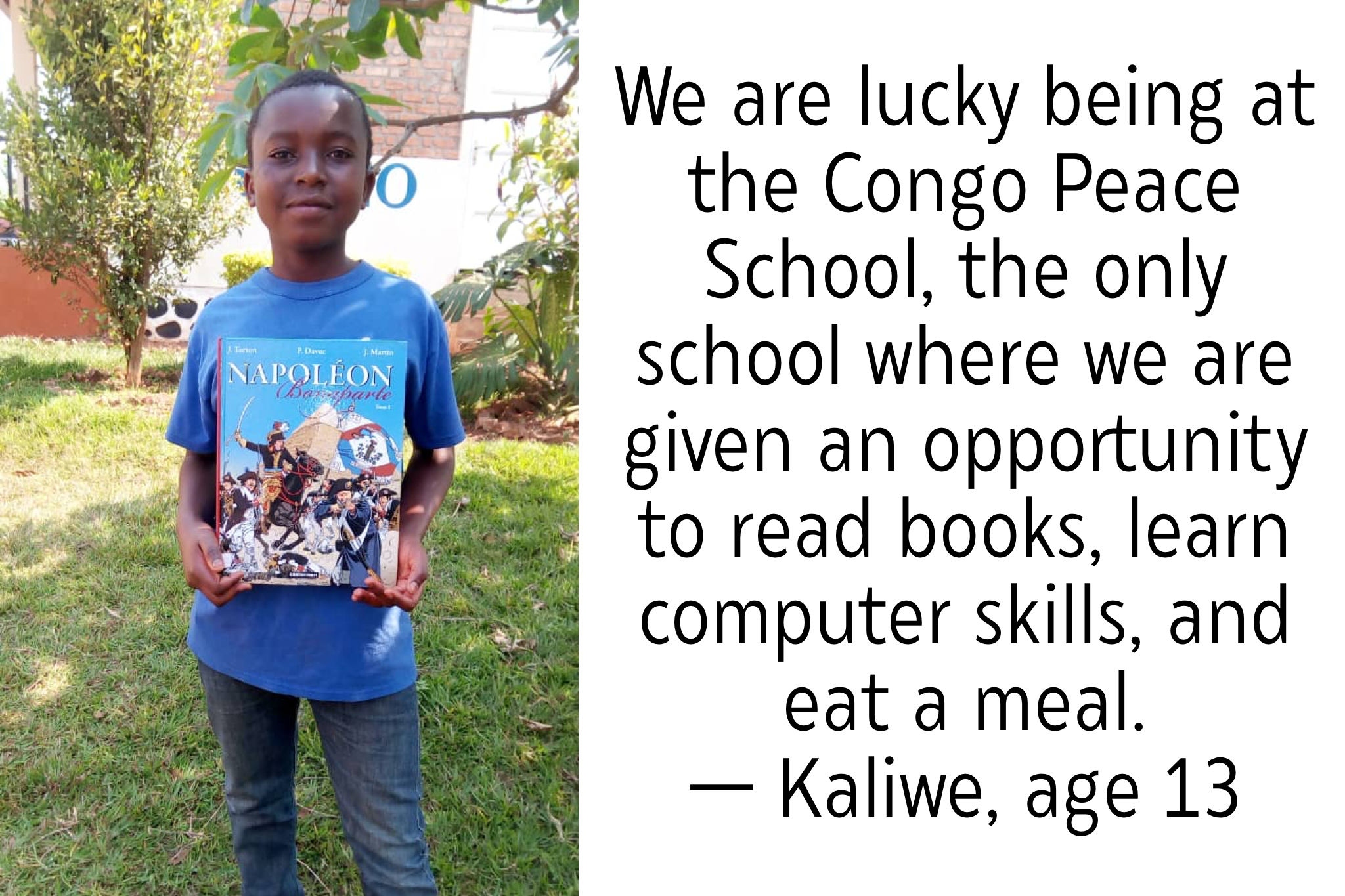
When he stepped away, a CPS alumnus named Kaliwe was chosen to take his place. Kaliwe graduated in 2024 at the top of the class, and is known as “a friend of books,” Amani shares.
We had first highlighted Kaliwe in an update in 2020, pictured holding a book about Napoleon. (Whatever your take on Napoleon, know that Kaliwe was introduced to this part of world history in the context of the Peace School’s curriculum that elevates and platforms local leadership and decolonizing one’s mind.)
Kaliwe today:
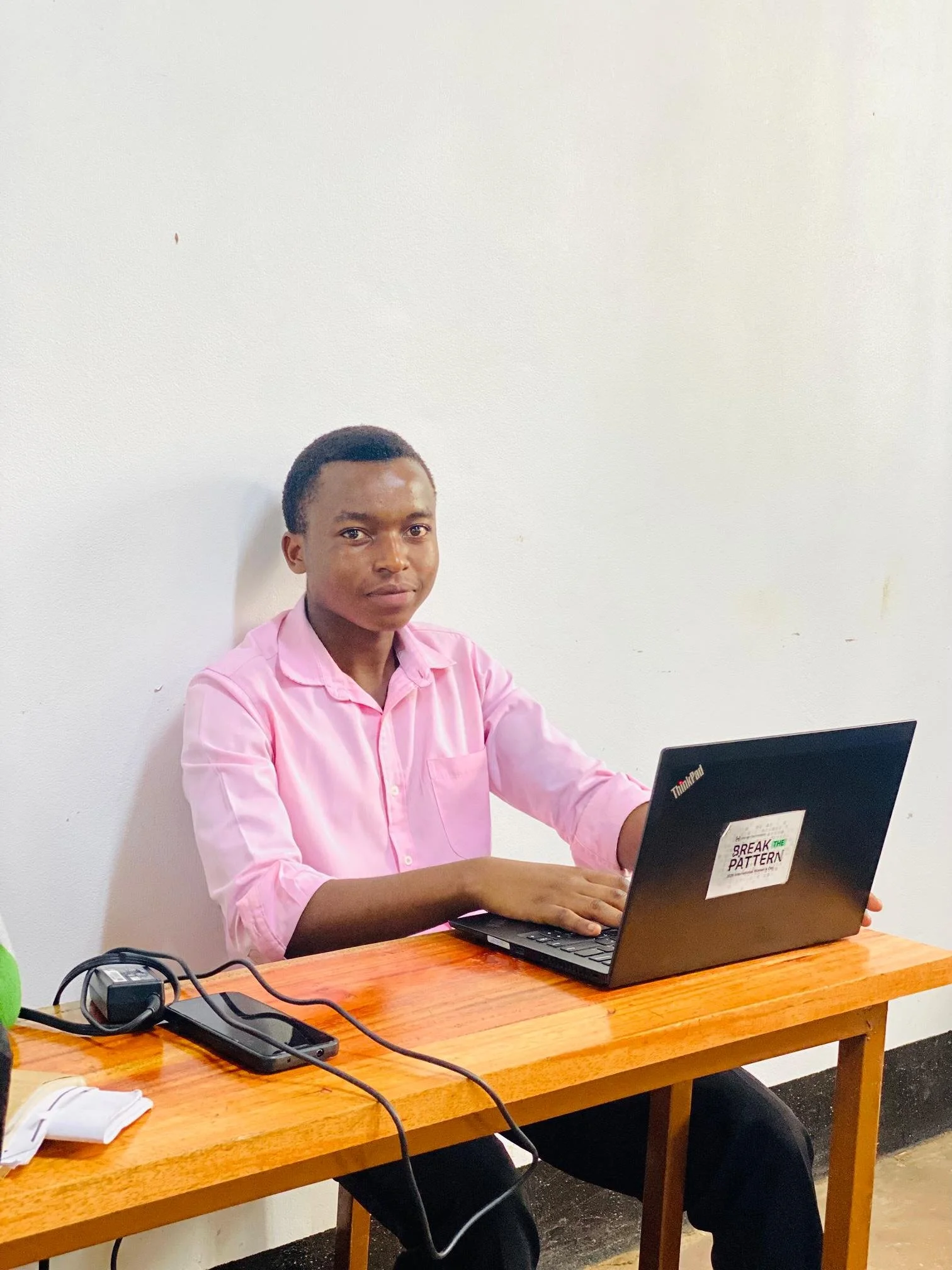
Kaliwe was 11 years old when he first came to the Congo Peace School. He lived with his mother and five older brothers at the time, one of whom was also a CPS student. Now in university, Kaliwe shares: “I am studying Business Information Systems and English. I made this choice thoughtfully, because I am convinced that today's world demands both technical skills and an international outlook. English allows me to communicate beyond my borders and access a vast world of knowledge, while Business Information Systems gives me the necessary tools to analyze, organize, and solve real-world problems in businesses and organizations.
“When I received my state diploma from Congo Peace School, my future still seemed uncertain, but I always held into a great hope and determination. I dreamed of one day setting foot on university campuses and pursuing higher education to acquire solid knowledge and skills that would allow me to build a better future. Despite everything, I remained determined to move forward and not abandon my ambitions and dream. I had nobody to support my university education until the founder of the Peace School sent Mr. Bertin to ask me if I could take a spot of a student who had stepped down and that day was a big joy in my lifetime.
“For me, education represented a gateway to a better future. I wanted not only to succeed academically, but also to become someone capable of making a positive contribution to my community and my country in general.
“After completing my university studies at the Universite Officielle de Bukavu, if possible, I would like to pursue a master's degree in either data science (artificial intelligence) or computer networks. My goal is to deepen my knowledge in one of these strategic fields in order to better understand and master modern technologies. I am convinced that these fields play a vital role in the development of today's world and especially the DRC which needs to make good use of its critical minerals and Artificial Intelligence and IT skills have a great role to play in this sector. In the long term, I hope to use these skills to contribute to a better future for the DRC, by providing technological solutions adapted to the realities of our country, particularly in systems management, communication, and innovation, despite current challenges (the war in the East). I also want to be part of this generation working for peace, progress, and stability using my academic skills.”
We asked Kaliwe, What would you like people in other parts of the world to know about you and about Congo Peace School?
“I would like people in other parts of the world to know that, despite the challenges we face, particularly in eastern DRC, I remain determined to continue my studies and build a better future. There is war going on and we need solidarity of the rest of the world to step in and put an end to this war.
“As for me, I would like them to understand that I am a committed young person, driven by a desire to learn, grow, and contribute positively to my community. My journey hasn't always been easy, but it has taught me resilience, perseverance, and the importance of never giving up on one’s dreams. I am who I am because of the solidarity of the supporters of Congo Peace School.”
Amani asked the same question of Samuel, one of the university students and Peace School alumni. He texted Amani the following:
Congo Peace School, Beacon of Hope
“In a world where education is often a luxury, the Congo Peace School is a beacon of hope. Congo Peace School is more than a school, it is a fountain where broken and stolen dreams return to life, a place where broken hearts regain courage. Many among those who were about to give up regain strength and move forward. When you see darkness, Congo Peace School is a candle of light.
“Congo Peace School is that hand we have been given to move towards a bright future. Congo Peace School is that voice that you hear every day telling you that you can make it, you can achieve your goals. It's a school from where you do not get only the intelligence from books, but you grow with positive character, hope and peace within. Many young people like me who thought there was no hope for a new future, that school made me feel everything was just beginning.
“Thank you to this school that is building leaders, shaping a destiny and is a living example of how peace is built from within and through education. May Congo Peace School live longer and keep educating our spirits and remain that place to heal our souls.”
I don’t know about you – but I needed to hear all of this from these students today. As Amani has said so many times, the world is torn apart, but together, we can repair the world. We cannot do this without you!
Ways to take action to keep the Congo Peace School open, educating children, and providing the means for lasting positive peace:
1. Donate! A huge thank you to those of you who give annual gifts as Guardian Donors (folks giving $5K or more at a commitment of three years) and those who give generously either annually or monthly via Patreon or our Action Kivu website. If you’re not committed financially, please consider even $3 a month. We know times are extremely tough for many right now.
2. Invite others to partner with the people of Congo: host a small gathering, a coffee meet-up, a dinner, and share some of the stories from Congo and why you continue to turn your attention to the children and their communities there. Invite others into the movement for peace through healing and education. More stories are here.
3. Introduce us to a board member of a foundation you know! We can take it from there, setting up a zoom with Amani and beginning that relationship of trust.
GROUNDEDNESS & TREE PLANTING:
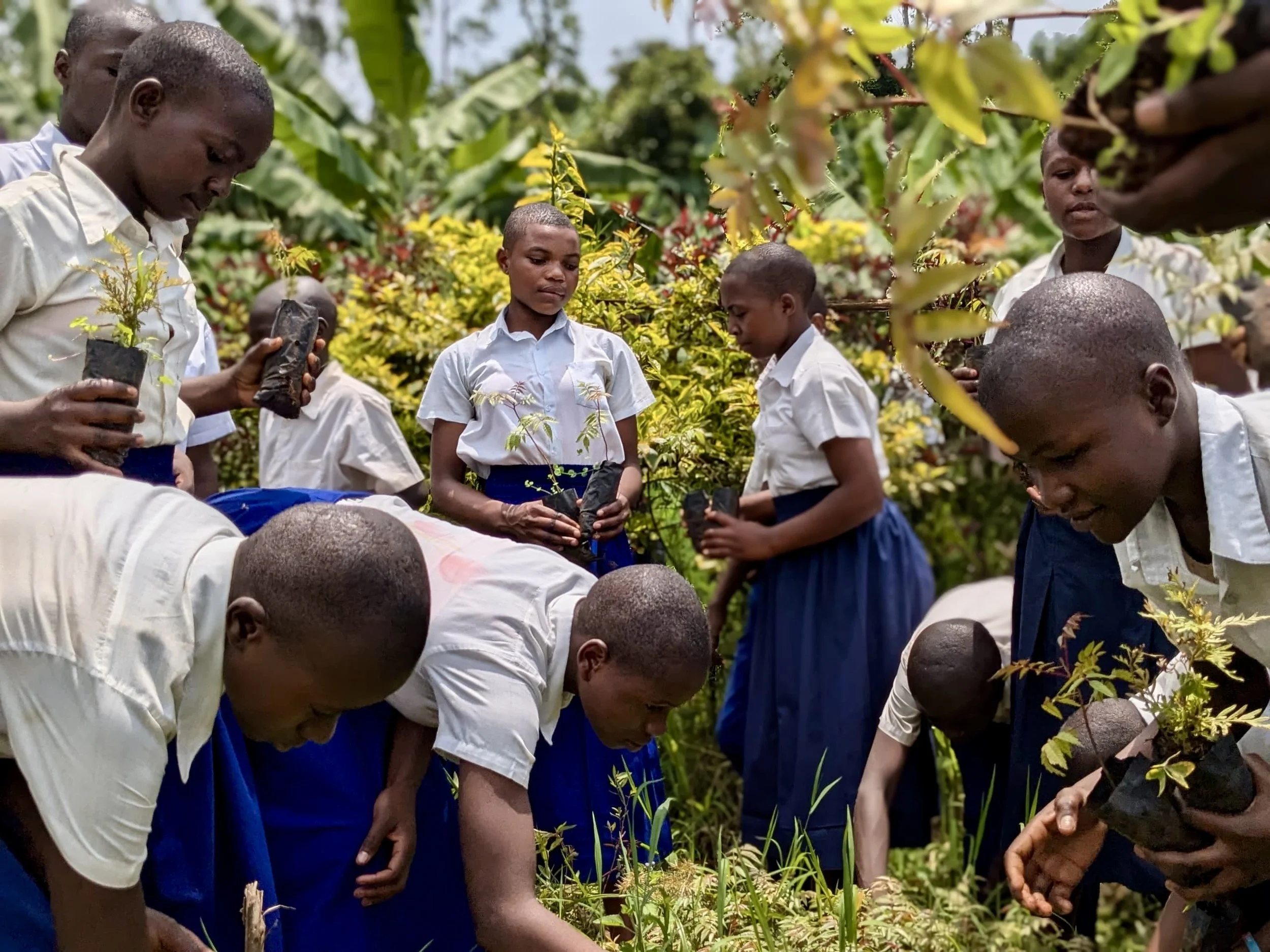
Within the Peace School’s curriculum, the students and staff learn not only the six principles of nonviolence from Martin Luther King, Jr., but also 64 daily practices, linked here. Earlier this spring, the Peace School students focused on the nonviolence practice of groundedness, learning to consciously calm oneself in difficult moments by remembering our connection to the ground and to our environment. The practical aspect of the lesson took the students outdoors, to plant seedlings. The marsh farm near the school that Action Kivu has long supported for community farming, animal husbandry, fishing ponds and regenerative farming practices offered the nursery space for the seedlings to grow and be planted during rainy season in March.
Each secondary school student planted three trees, mindful of their connection to the earth as they dug their fingers into the rich soil, as well as contemplating how the trees play a role in combatting climate crisis and preventing the degradation of the soil, shoring up the land against biodiversity loss and pollution. Inherent in the hands-on approach of learning the principles of nonviolence, the tree planting is also an implementation of Zero Waste Education, empowering future generations. This summer, the nursery will yield fruit trees for each student to take home and plant at the community level, to provide nutrition for local families.
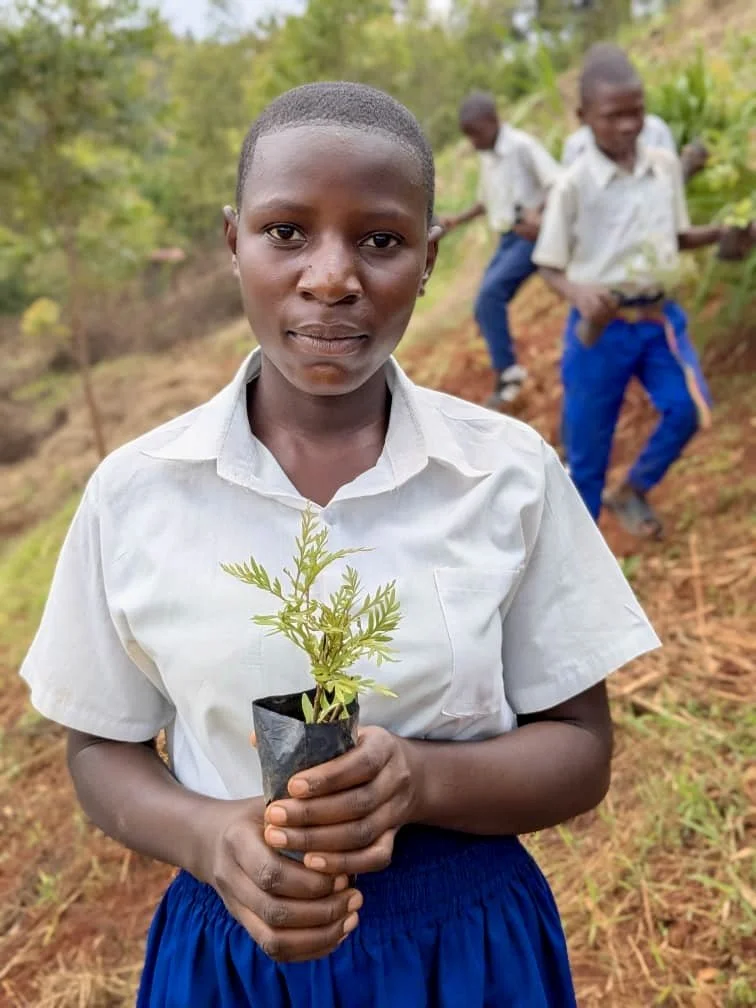
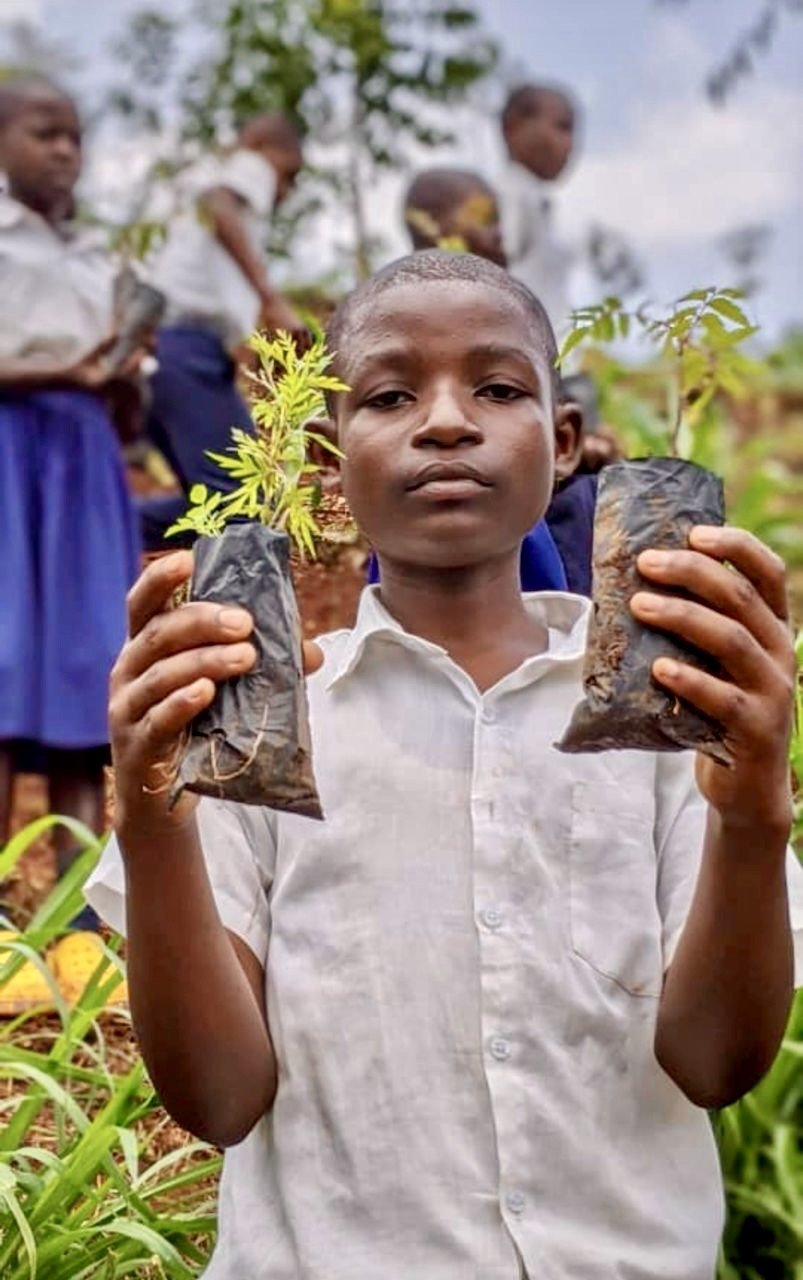
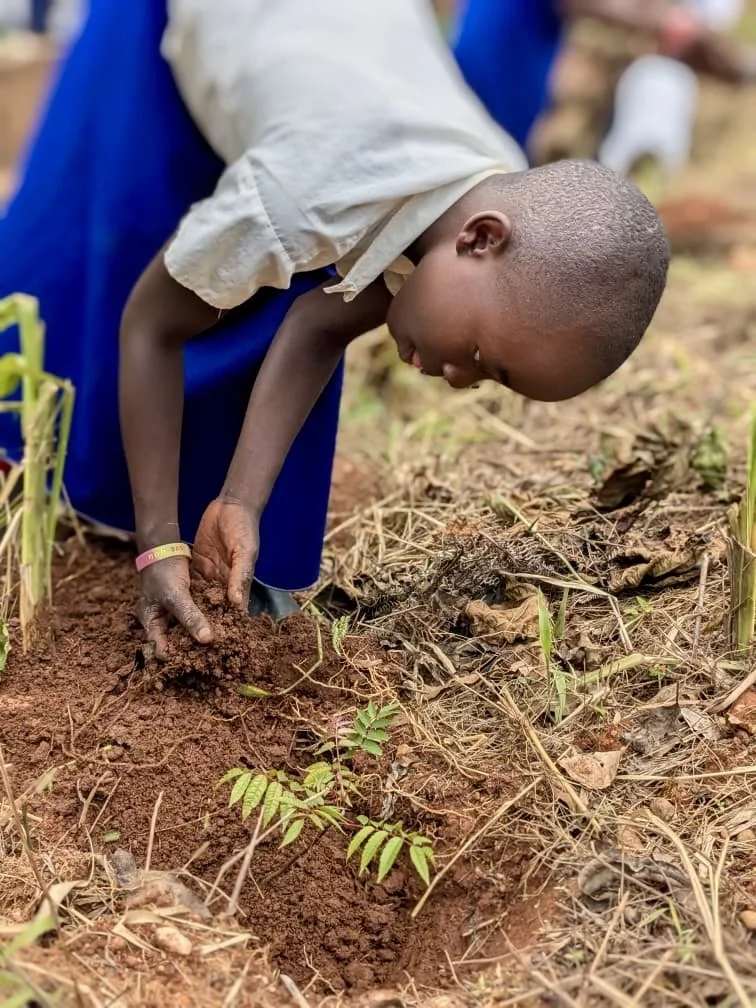
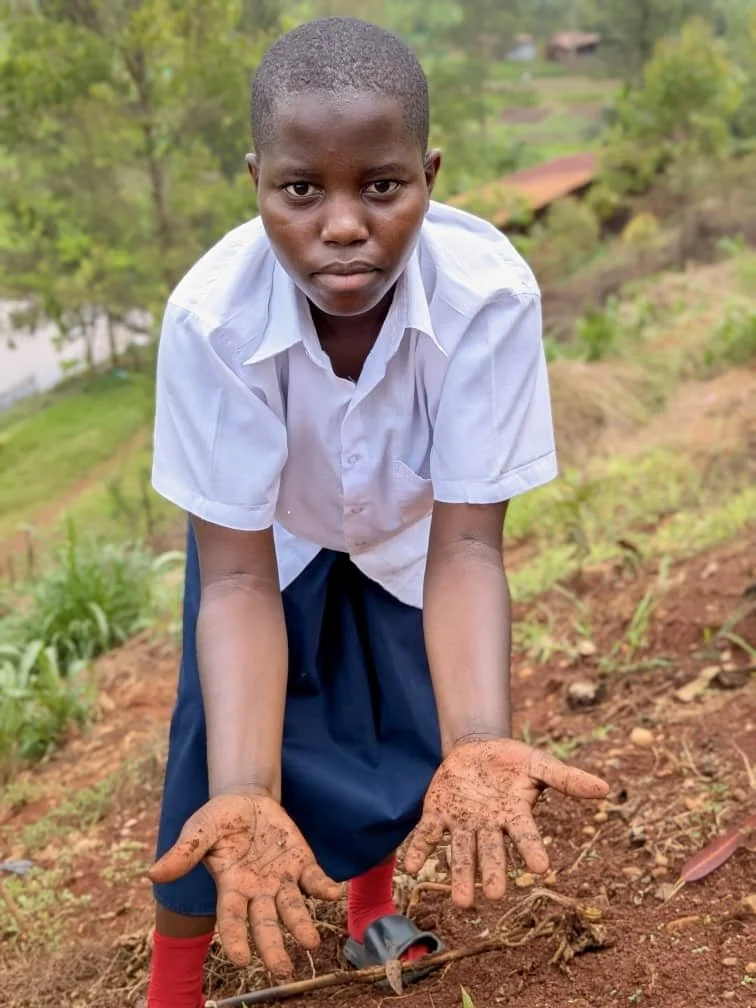
This final photo is Anouarite, a student whose path we have highlighted since the construction of the Congo Peace School. At that time, Anouarite had joined the adult women’s literacy program, so desperate to get an education that her family could not afford to give her. She boldly asked Amani if she could be a student when the Peace School opened, and has flourished ever since.
May Anouarite’s open hands, covered in the rich dirt from planting trees that will bring her community cleaner air and fresh fruit, be a reminder of our gratitude to you for investing in the lives of the children of Congo, in healing trauma, and in creating positive peace for us all.