

NEWS
Spring at the Congo Peace School: Positive vs "obnoxious" peace, updates from alumni + tree planting to practice nonviolence
I first heard the term positive peace when I began working with Amani Matabaro. Previously, I’d not been taught much about Martin Luther King Jr.’s concepts of peace and nonviolence beyond the overarching ideas referenced in quotes every February. Amani (whose name translates as “peace” in Swahili), not only amplifies King’s teachings about positive peace, but, through your support, is instilling the foundations of it in the children in eastern Congo, in the midst of war.
In a sermon titled “When Peace Becomes Obnoxious,” King taught that “Peace is not merely the absence of some negative force—war, tension, confusion, but it is the presence of some positive force—justice, goodwill, the power of the kingdom of God.”
Before meeting Amani, I’d not thought deeply about the implications of negative (obnoxious) peace, “this peace of escapism, this peace that fails to confront the real issues of life, the peace that makes for stagnant complacency,” as King explained. From my place of privilege, I’d not explored the question: what does positive peace look like when embodied, and even more so, made real in a region decimated by decades upon decades of violence?
The current war in Congo, this most recent outbreak of active violence that started in January 2025, drags on, despite occasional headlines that give a surge of hope for peace, reports that tout a return to the negative peace that has been the status quo for the people of Congo living in extreme poverty and outbursts of violence while the world is enriched by the country’s rare earth minerals, a norm that Amani and his community of civil society leaders have been working to change for over 30 years. This active war and occupation of M23 in cities in eastern Congo must end, and the implementation of positive peace must be closely monitored, with civil society advocates leading the way.
Through Amani and his community building in Congo, you too are a partner with the people of Congo in creating positive peace, through your gifts of money and attention. Together, we’ve been laying the groundwork for positive peace in building capacity for equality for women and girls and an end to domestic violence and rape as a weapon of war. We’ve been working to eradicate violence in word and deed through trauma healing. We’ve been planting trees to address the climate crisis (read more below). We’ve been planting seeds to feed families and teaching vocational skills and literacy to alleviate extreme poverty. Together, we’ve all been planting seeds of hope and a better future in the students attending the Congo Peace School.
As spring unfolds in eastern Congo, trees are leafing and fruit is starting to grow to feed the Peace School students and their community. Students are continuing to weather the war through the hope for lasting, positive peace that the school teaches is possible.
Six of the graduates of the Congo Peace School [CPS] are currently attending university, thanks to our CPS founding partner, the Dillon Henry Foundation’s Harriet Zaretsky. Harriet embodies putting her money where her mouth is (and heart / soul); when she first heard Amani speak about his dream of a school rooted in the teachings of peace and nonviolence, she found the means to build the campus and then engage many of her community in committing the funds to pay teachers, feed the students, and buy supplies alongside Action Kivu supporters. When the first class of seniors graduated in 2023, Harriet started a scholarship program for six of the top students, three young women and three young men. (We wish we could send more students to higher education, but first we must meet the Peace School’s annual budget, and secure funding for that year-over-year. More on how to help with that below!)
One of the college students recently needed to take a break. The six in university are supported not only financially but also by regular visits from one of the CPS staff members. After speaking to the young man who was struggling, it was agreed he needed to continue in his psychological healing before he could take on the rigors of university.
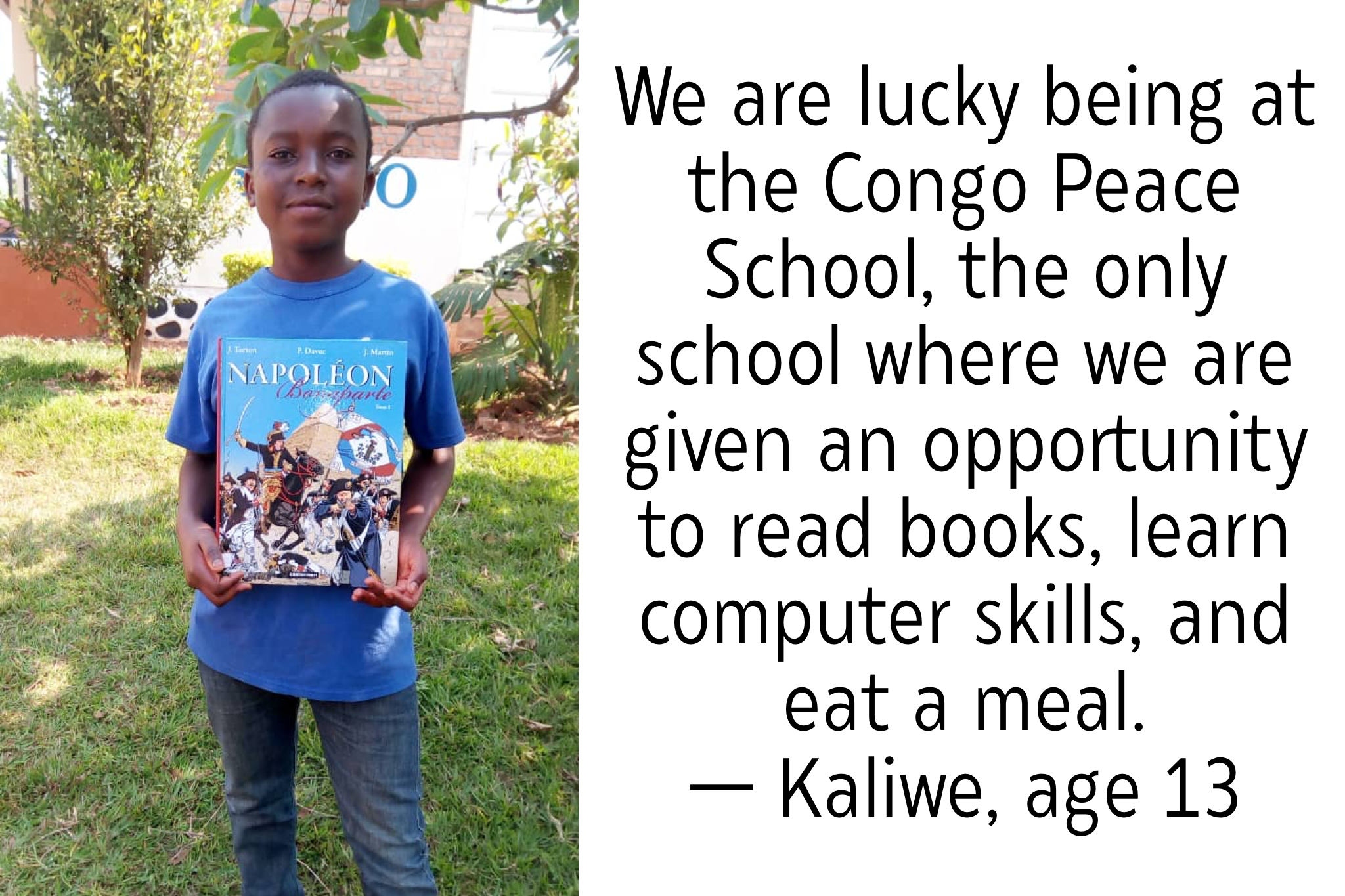
When he stepped away, a CPS alumnus named Kaliwe was chosen to take his place. Kaliwe graduated in 2024 at the top of the class, and is known as “a friend of books,” Amani shares.
We had first highlighted Kaliwe in an update in 2020, pictured holding a book about Napoleon. (Whatever your take on Napoleon, know that Kaliwe was introduced to this part of world history in the context of the Peace School’s curriculum that elevates and platforms local leadership and decolonizing one’s mind.)
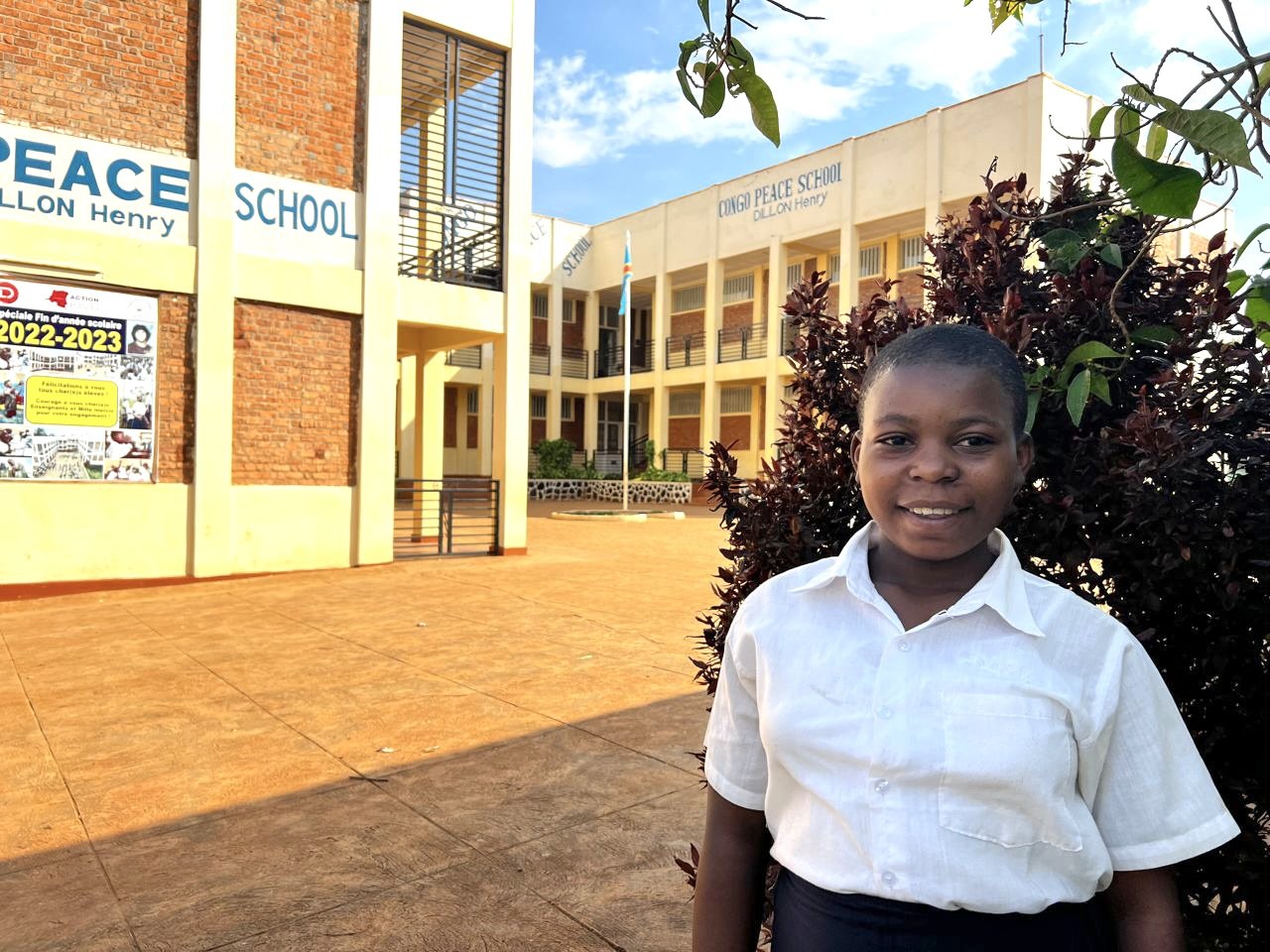
Kaliwe today:
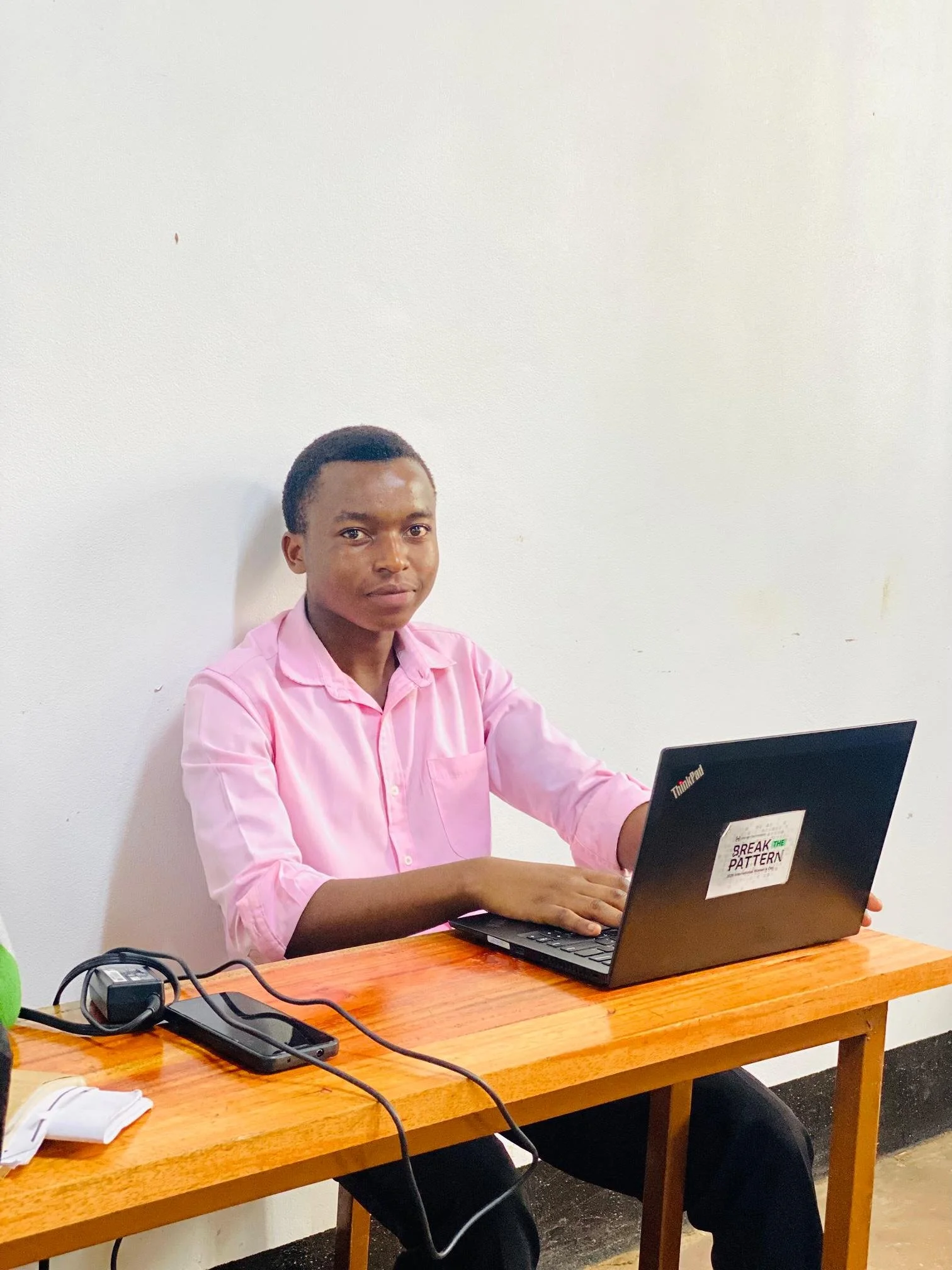
Kaliwe was 11 years old when he first came to the Congo Peace School. He lived with his mother and five older brothers at the time, one of whom was also a CPS student. Now in university, Kaliwe shares: “I am studying Business Information Systems and English. I made this choice thoughtfully, because I am convinced that today's world demands both technical skills and an international outlook. English allows me to communicate beyond my borders and access a vast world of knowledge, while Business Information Systems gives me the necessary tools to analyze, organize, and solve real-world problems in businesses and organizations.
“When I received my state diploma from Congo Peace School, my future still seemed uncertain, but I always held into a great hope and determination. I dreamed of one day setting foot on university campuses and pursuing higher education to acquire solid knowledge and skills that would allow me to build a better future. Despite everything, I remained determined to move forward and not abandon my ambitions and dream. I had nobody to support my university education until the founder of the Peace School sent Mr. Bertin to ask me if I could take a spot of a student who had stepped down and that day was a big joy in my lifetime.
“For me, education represented a gateway to a better future. I wanted not only to succeed academically, but also to become someone capable of making a positive contribution to my community and my country in general.
“After completing my university studies at the Universite Officielle de Bukavu, if possible, I would like to pursue a master's degree in either data science (artificial intelligence) or computer networks. My goal is to deepen my knowledge in one of these strategic fields in order to better understand and master modern technologies. I am convinced that these fields play a vital role in the development of today's world and especially the DRC which needs to make good use of its critical minerals and Artificial Intelligence and IT skills have a great role to play in this sector. In the long term, I hope to use these skills to contribute to a better future for the DRC, by providing technological solutions adapted to the realities of our country, particularly in systems management, communication, and innovation, despite current challenges (the war in the East). I also want to be part of this generation working for peace, progress, and stability using my academic skills.”
We asked Kaliwe, What would you like people in other parts of the world to know about you and about Congo Peace School?
“I would like people in other parts of the world to know that, despite the challenges we face, particularly in eastern DRC, I remain determined to continue my studies and build a better future. There is war going on and we need solidarity of the rest of the world to step in and put an end to this war.
“As for me, I would like them to understand that I am a committed young person, driven by a desire to learn, grow, and contribute positively to my community. My journey hasn't always been easy, but it has taught me resilience, perseverance, and the importance of never giving up on one’s dreams. I am who I am because of the solidarity of the supporters of Congo Peace School.”
Amani asked the same question of Samuel, one of the university students and Peace School alumni. He texted Amani the following:
Congo Peace School, Beacon of Hope
“In a world where education is often a luxury, the Congo Peace School is a beacon of hope. Congo Peace School is more than a school, it is a fountain where broken and stolen dreams return to life, a place where broken hearts regain courage. Many among those who were about to give up regain strength and move forward. When you see darkness, Congo Peace School is a candle of light.
“Congo Peace School is that hand we have been given to move towards a bright future. Congo Peace School is that voice that you hear every day telling you that you can make it, you can achieve your goals. It's a school from where you do not get only the intelligence from books, but you grow with positive character, hope and peace within. Many young people like me who thought there was no hope for a new future, that school made me feel everything was just beginning.
“Thank you to this school that is building leaders, shaping a destiny and is a living example of how peace is built from within and through education. May Congo Peace School live longer and keep educating our spirits and remain that place to heal our souls.”
I don’t know about you – but I needed to hear all of this from these students today. As Amani has said so many times, the world is torn apart, but together, we can repair the world. We cannot do this without you!
Ways to take action to keep the Congo Peace School open, educating children, and providing the means for lasting positive peace:
1. Donate! A huge thank you to those of you who give annual gifts as Guardian Donors (folks giving $5K or more at a commitment of three years) and those who give generously either annually or monthly via Patreon or our Action Kivu website. If you’re not committed financially, please consider even $3 a month. We know times are extremely tough for many right now.
2. Invite others to partner with the people of Congo: host a small gathering, a coffee meet-up, a dinner, and share some of the stories from Congo and why you continue to turn your attention to the children and their communities there. Invite others into the movement for peace through healing and education. More stories are here.
3. Introduce us to a board member of a foundation you know! We can take it from there, setting up a zoom with Amani and beginning that relationship of trust.
GROUNDEDNESS & TREE PLANTING:
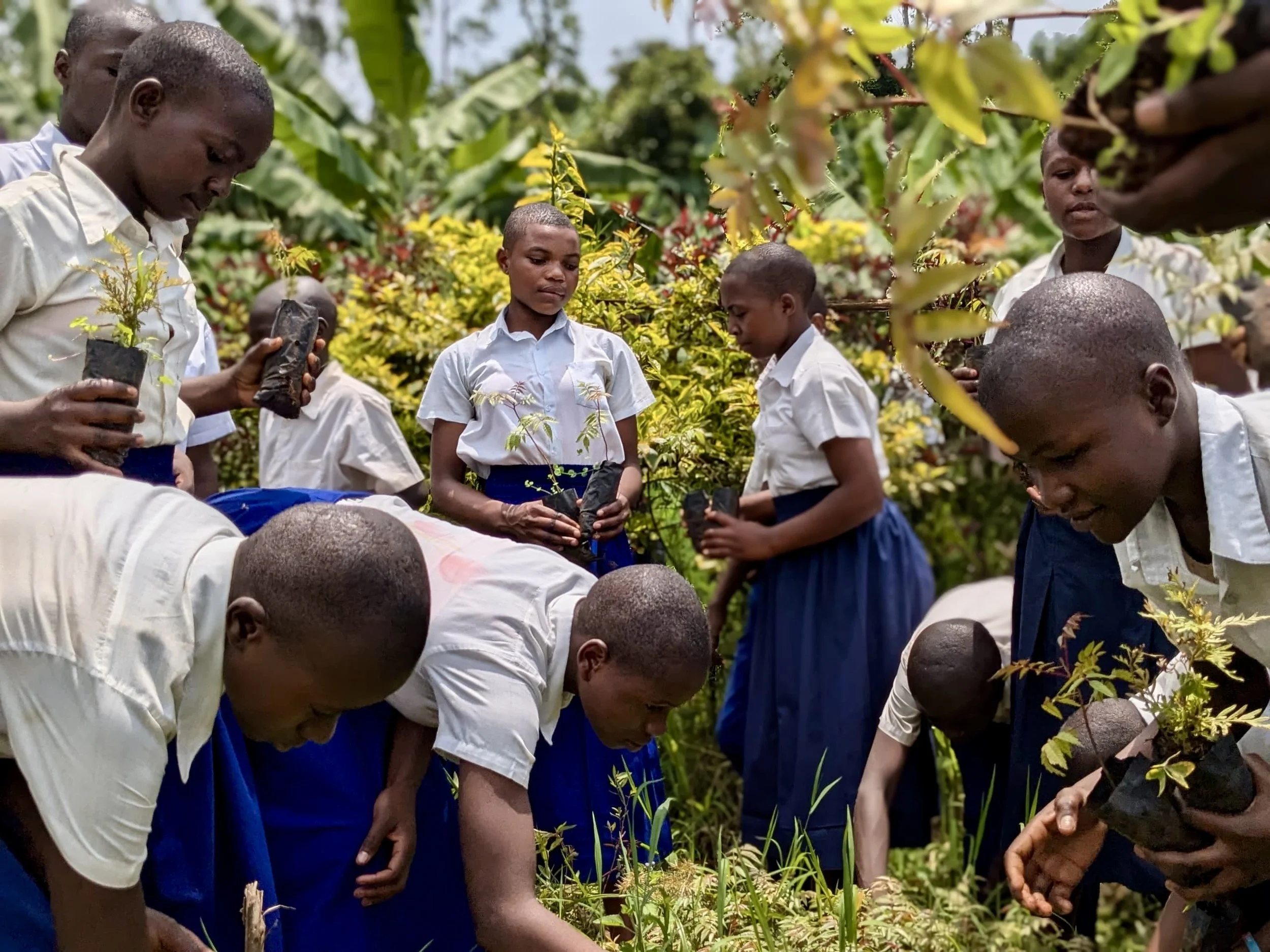
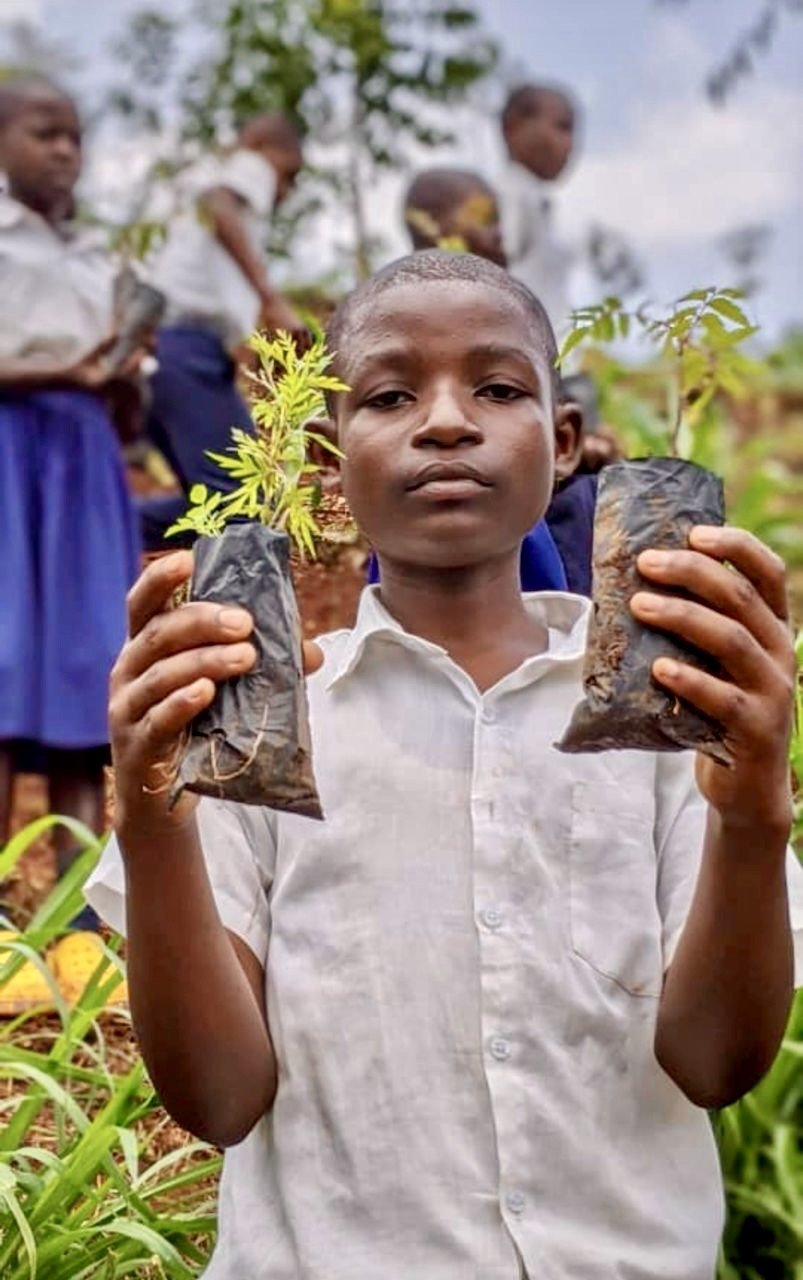
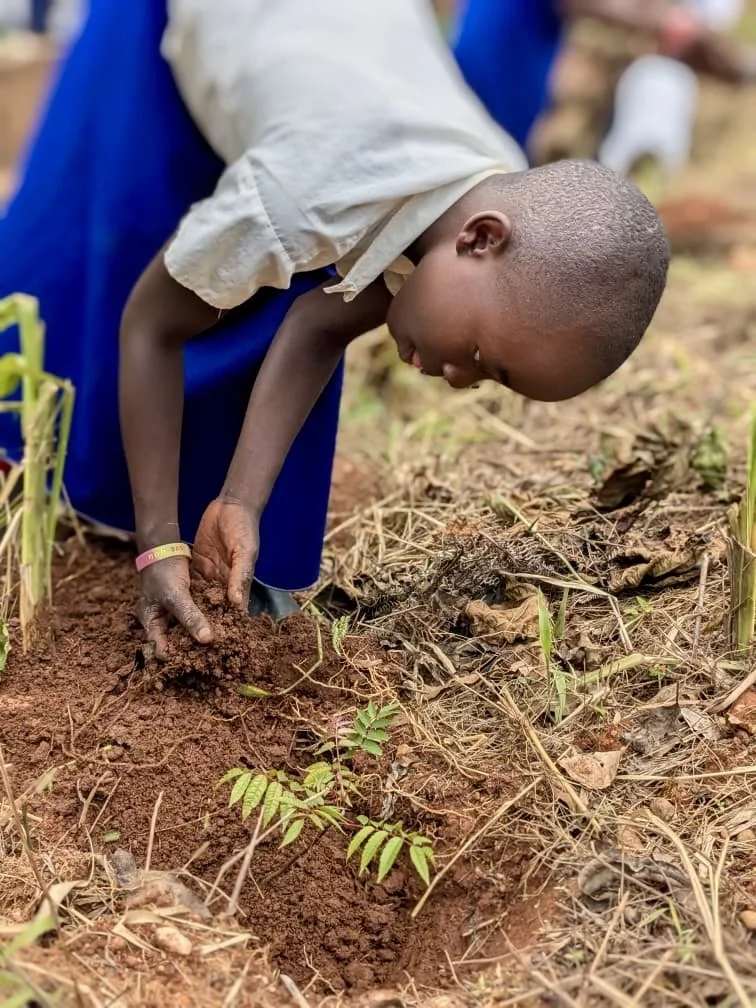
Within the Peace School’s curriculum, the students and staff learn not only the six principles of nonviolence from Martin Luther King, Jr., but also 64 daily practices, linked here. Earlier this spring, the Peace School students focused on the nonviolence practice of groundedness, learning to consciously calm oneself in difficult moments by remembering our connection to the ground and to our environment. The practical aspect of the lesson took the students outdoors, to plant seedlings. The marsh farm near the school that Action Kivu has long supported for community farming, animal husbandry, fishing ponds and regenerative farming practices offered the nursery space for the seedlings to grow and be planted during rainy season in March.
Each secondary school student planted three trees, mindful of their connection to the earth as they dug their fingers into the rich soil, as well as contemplating how the trees play a role in combatting climate crisis and preventing the degradation of the soil, shoring up the land against biodiversity loss and pollution. Inherent in the hands-on approach of learning the principles of nonviolence, the tree planting is also an implementation of Zero Waste Education, empowering future generations. This summer, the nursery will yield fruit trees for each student to take home and plant at the community level, to provide nutrition for local families.
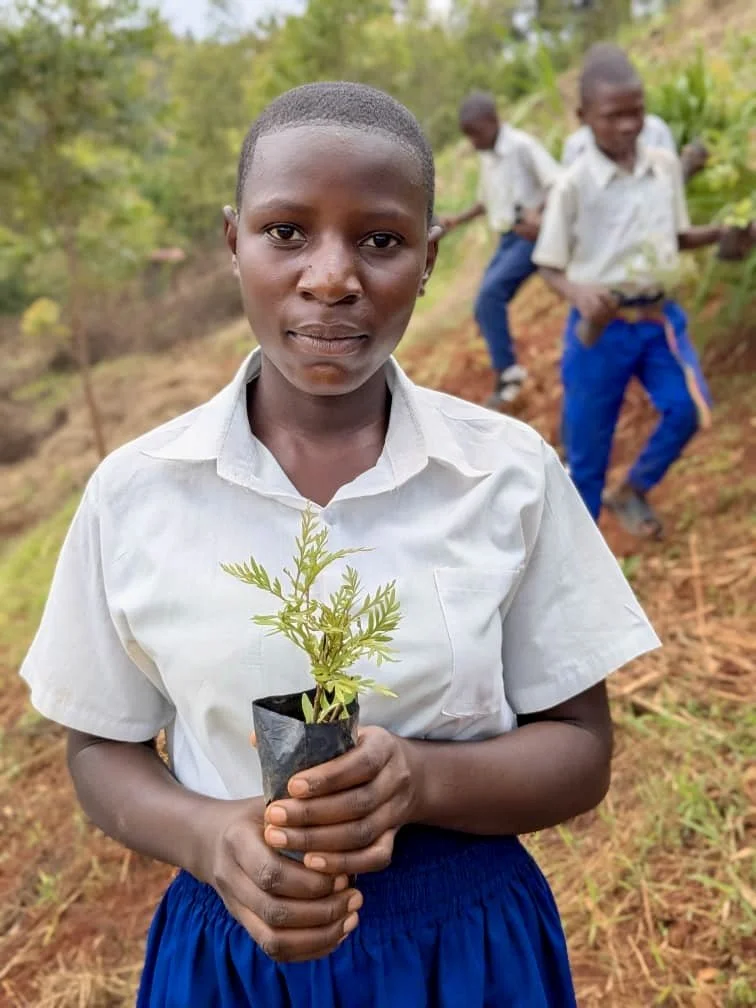
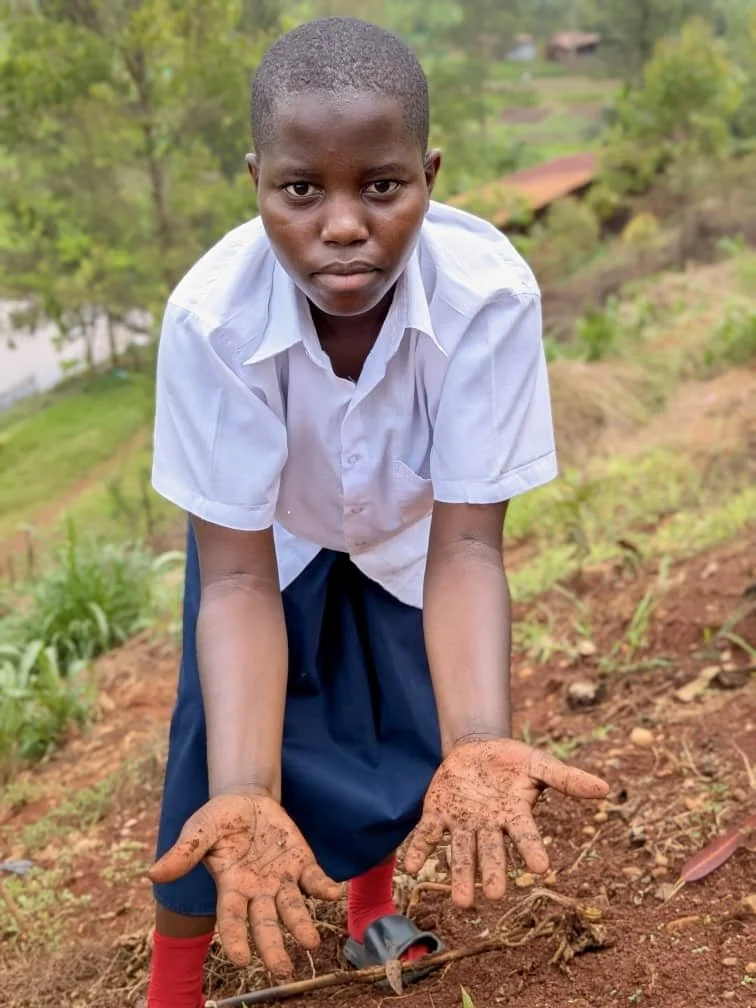
This final photo is Anouarite, a student whose path we have highlighted since the construction of the Congo Peace School. At that time, Anouarite had joined the adult women’s literacy program, so desperate to get an education that her family could not afford to give her. She boldly asked Amani if she could be a student when the Peace School opened, and has flourished ever since.
May Anouarite’s open hands, covered in the rich dirt from planting trees that will bring her community cleaner air and fresh fruit, be a reminder of our gratitude to you for investing in the lives of the children of Congo, in healing trauma, and in creating positive peace for us all.
Unreported stories of war, plus hope, curiosity, and healing at the Congo Peace School
Driving to the grocery store and listening to the radio, I heard the words “in eastern Democratic Republic of Congo, government forces supported by militia groups are engaged in fierce fighting with M23 rebels backed by neighboring Rwanda.”
I audibly gasped – a news story on All Things Considered about the war in Congo? With all the horrors in the world’s and nation’s news cycles, it’s not common to hear about DRC without specifically searching for a story. (And with all the horrors of the news cycle, we appreciate you turning your attention to Congo right now, and sharing in the stories of the folks who are so often overlooked while we all benefit from the wealth being extracted from their country.)
The story is not a run of the mill report, but in merely four minutes they speak to soldiers and survivors and touch on some of the causes of the war. One soldier with the Congolese army noted that he has not been paid in six months. How does one survive without pay, you might ask (as we all hear increasing reports of AI taking jobs). If you’re a civilian, people are NOT surviving.
Below, reports on how the war, now over a year old, is killing folks through hunger and preventable disease, and how your partnership with the Congo Peace School community is actually saving lives.
Also below, some of the students share what life has been like for them at the school during these first months of the new year, and send a message of thanks.
And lastly, we need your help / connections / ideas for a musician for an upcoming fundraising event. The backstory: for several years the Congo Peace School has been generously supported not only by you, but through our Founding CPS Partner the Dillon Henry Foundation, we have received annual funding from the Judy Bork Trust, ranging from $50K to over $100K per year. That support has come to an end, as planned by Judy herself, to fully spend the trust in a specific period of time. We are so grateful for that support, and received some sustainability funding from the trustees as well, and plan to use some of the funds towards a big fundraiser to bring more and more people together and raise some significant money to keep this critical school open.
To do that, we need a name that will draw people who will buy tickets! Do you have a connection to a popular, amazing musician that you could introduce us to? Other ideas to find someone? Email me (Rebecca) at actionkivu@gmail.org.
Unreported effects of war
Our Founding Director Amani Matabaro shared how before the war, the women in the Mumosho community used to earn small amounts of money through small shops, selling goods to local Congolese neighbors that they had purchased wholesale across the border in Rwanda. With the sales, they were able to feed their children a small amount of food each day. Mothers, Amani said, used to do cross-border trade, to keep their children alive.
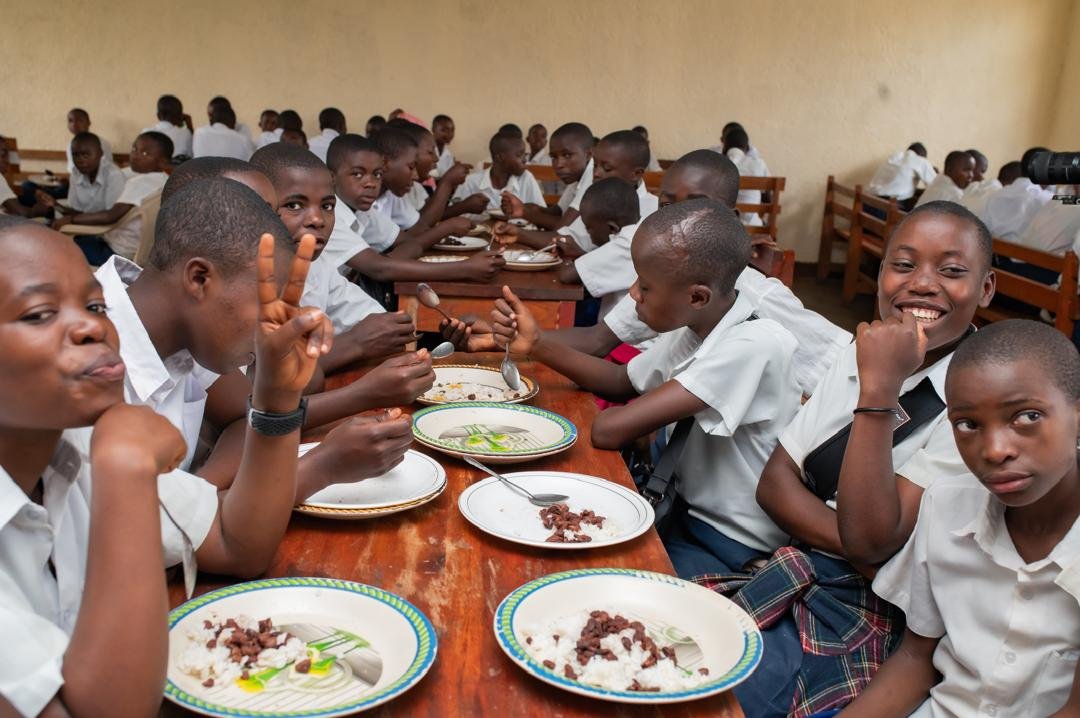
The war has closed borders and banks in Congo. For those women who *are* able to cross into Rwanda, they are no longer offered wholesale prices, so there is almost zero profit for their labor. Women are not able to feed their children. Even more students at the Congo Peace School only eat because of your support and our cafeteria. (With the banks closed, our team has created a workaround with checks and mobile money, and your donations are making the most impact possible.)
The destruction of USAID support in Africa without a plan in place for local communities to work towards building that infrastructure has also killed people who were depending on medicines and vaccines – your support of the Congo Peace School, whether it is through a financial gift, a bake-sale, or connecting us to others who can help, will save lives, and invests in a future of peace-filled leaders. As Amani often reminds us, trauma not transformed is transferred.
These students are transforming their trauma:
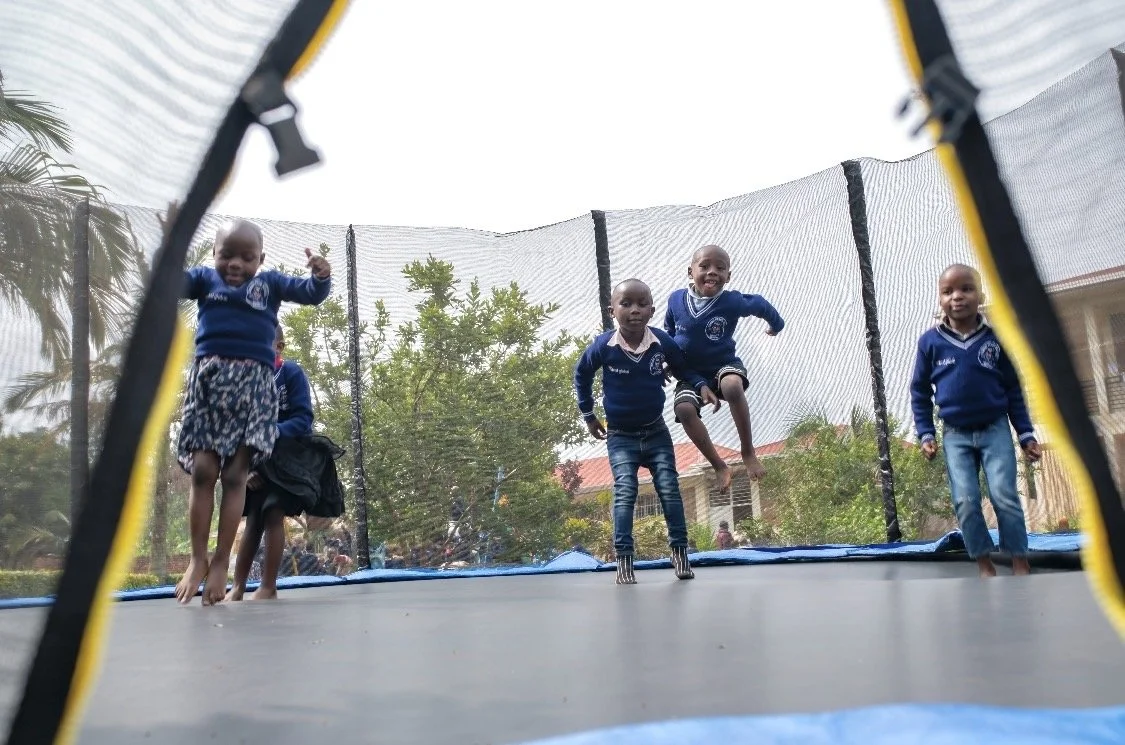
Young students in blue Nest Global sweaters (the Congo Peace School’s preschool partner) bounce on a trampoline inside a safety enclosure.
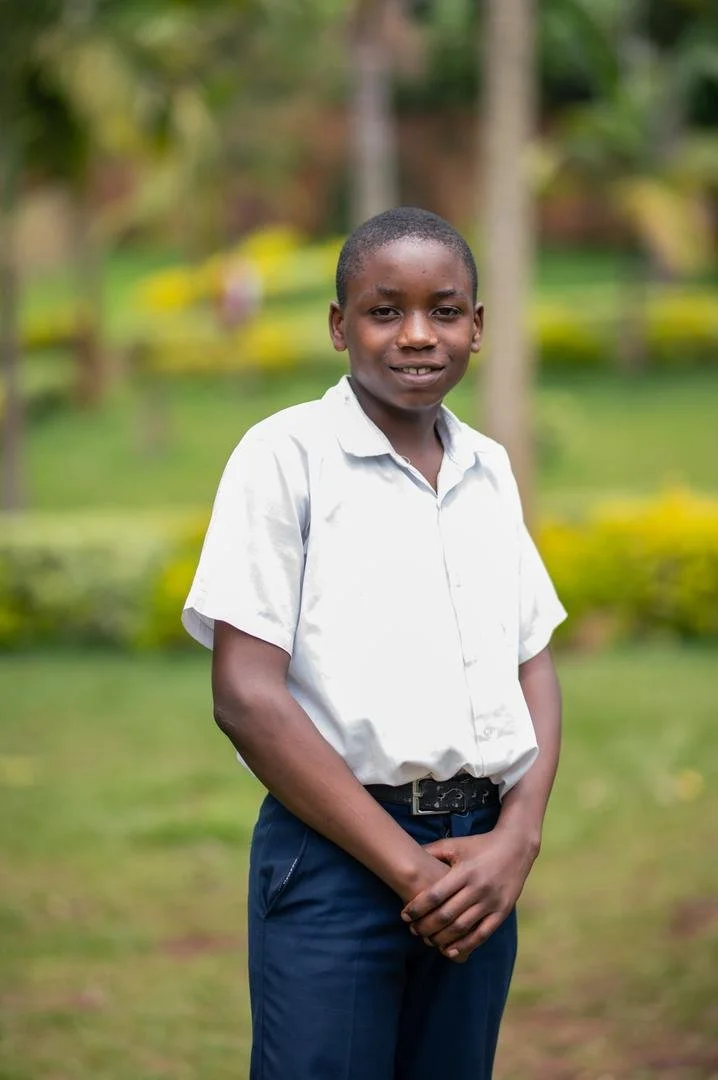
Bahati Akonkwa Emmanuel
“I am in 2nd grade of secondary school (7th grade in the U.S. system) at the Peace School, and I’m 13 years old. I live with my grandmother; I don’t know where my parents are since this war broke out. This is the most difficult situation I’ve ever lived in my life. I am praying every day to see this war come to an end. I like the Congo Peace School, at least [here] you have support when you feel exhausted, hopeless and anxious, our school trauma program is highly helpful.”
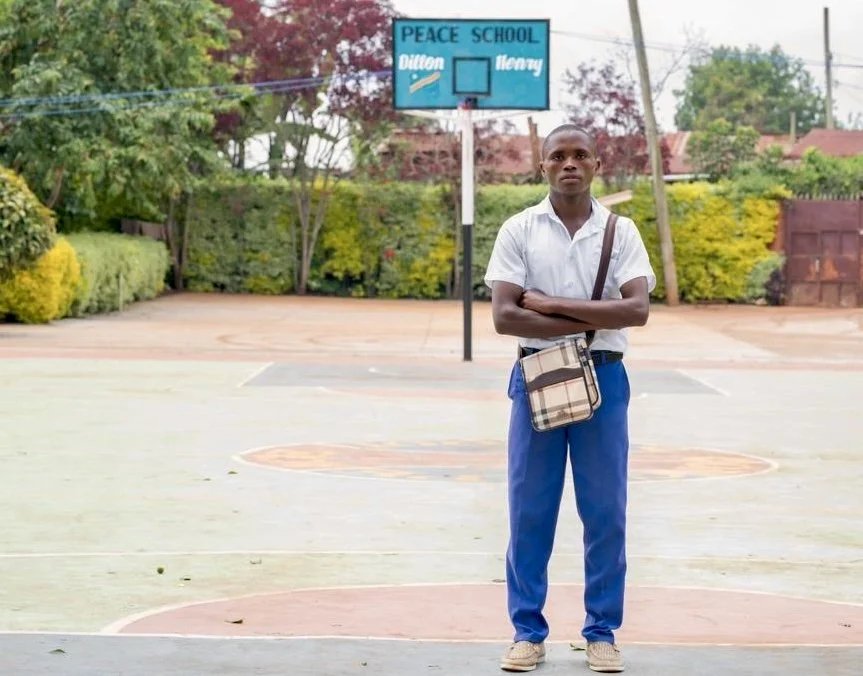
Mwaka Munguakonkwa Jean de Dieu
“I am 18 years old, in the 5thgrade of secondary at the Congo Peace School (11th grade in the U.S. system). I live with my mother, my father passed away. I have five brothers and two sisters. My mother sustains us as a family by doing small scale agriculture after her other small trade business was ended when the war in our country broke out. I am here at the Peace School as a new student as we were forced to flee our home and learned the surrounding area of the Peace School was safe, and this is how we settled in Mumosho. The Peace School is better than where I was studying before. Peace and Nonviolence are good subjects to talk about even if there is war going on right now in our country. This war is all about minerals, we did not know before until we started seeing almost all the agreements are about the minerals the DRC has.”
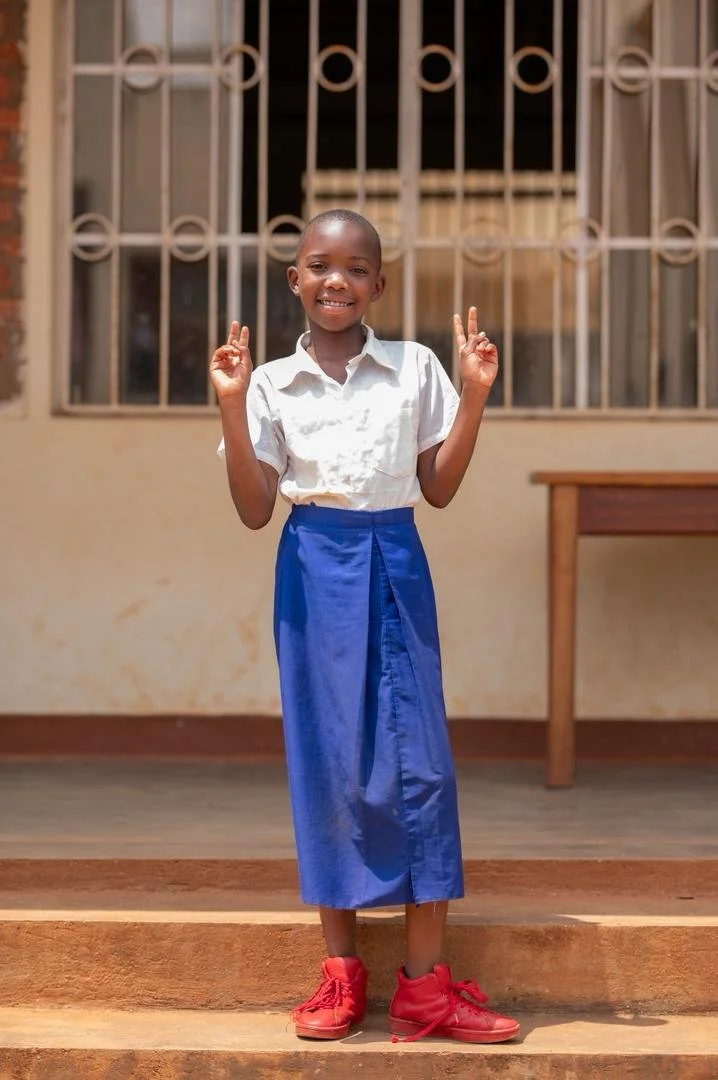
Faraja Mihigo Nice
“I am 10 years old, and am in 5th grade of elementary school at the Peace School, which has become home for me. This time of war is very difficult, we are suffering. We are living with fear because you do not know what could happen, anything could happen any time. We have no money to buy food, medical care, and other things we need. I wonder if the Congo Peace School was not taking care of us what would happen, maybe we would have died.”
Amani shared recently how it feels the world has turned away from the suffering of the people of Congo. World leaders know that the critical minerals are being smuggled across the border to Rwanda, washed and put into our supply chains, making all of our lives easier and richer, with our cell phones and laptops and electric cars and airplane engines, blood minerals that fuel a life that these innocent faces have to endure in fear of violence and not knowing if they will eat enough to survive.
We are grateful beyond the words we have to express the gratitude, that you have turned your attention to the innocent children of Congo. For you to share these stories with others so our circle of connection and work for peace around the globe continues to grow. That you are investing in a future of peace and social justice for us all by investing in peace in Congo.
“Thank you so much to Congo Peace School! Thank you! Asanteni!”
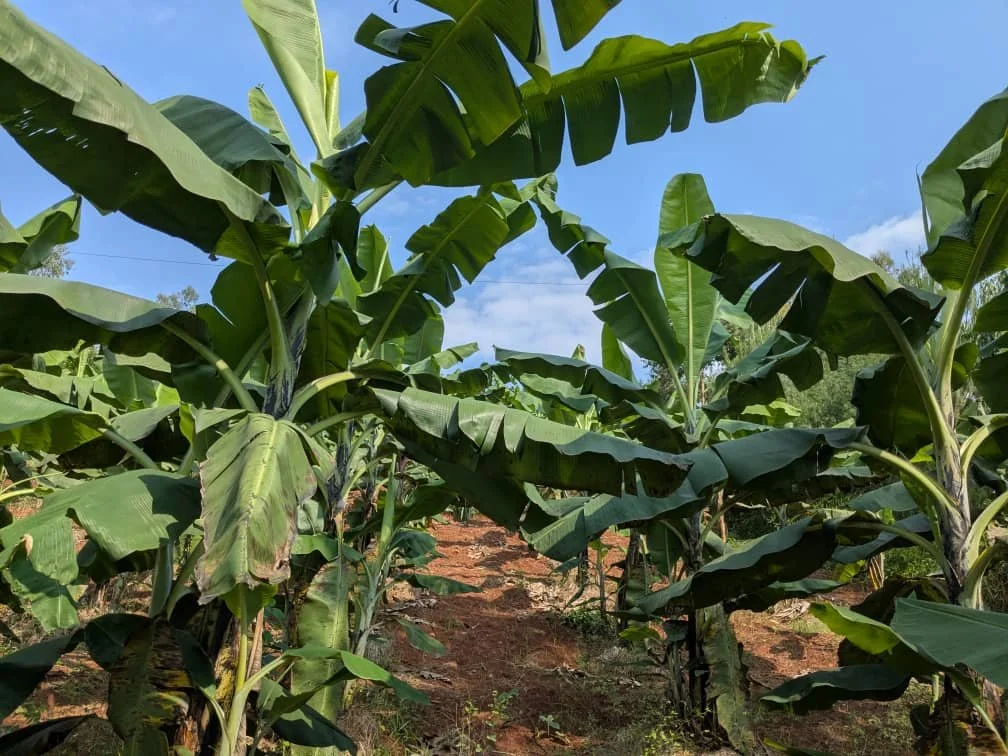
Bonus: We will soon have bananas to supplement the students’ meals! Amani’s daughter Blessing majored in agronomy in university, and wanted to put her new knowledge to use to benefit the students at the Congo Peace School. The young banana trees were purchased with Action Kivu funds from an agricultural research center, and will be part of the regenerative farming plan, especially necessary after a company working on the road above the marsh farm dumped infertile dirt onto the land. We will soon know more about the harvest yield and will share that with all of you, our beloved community.
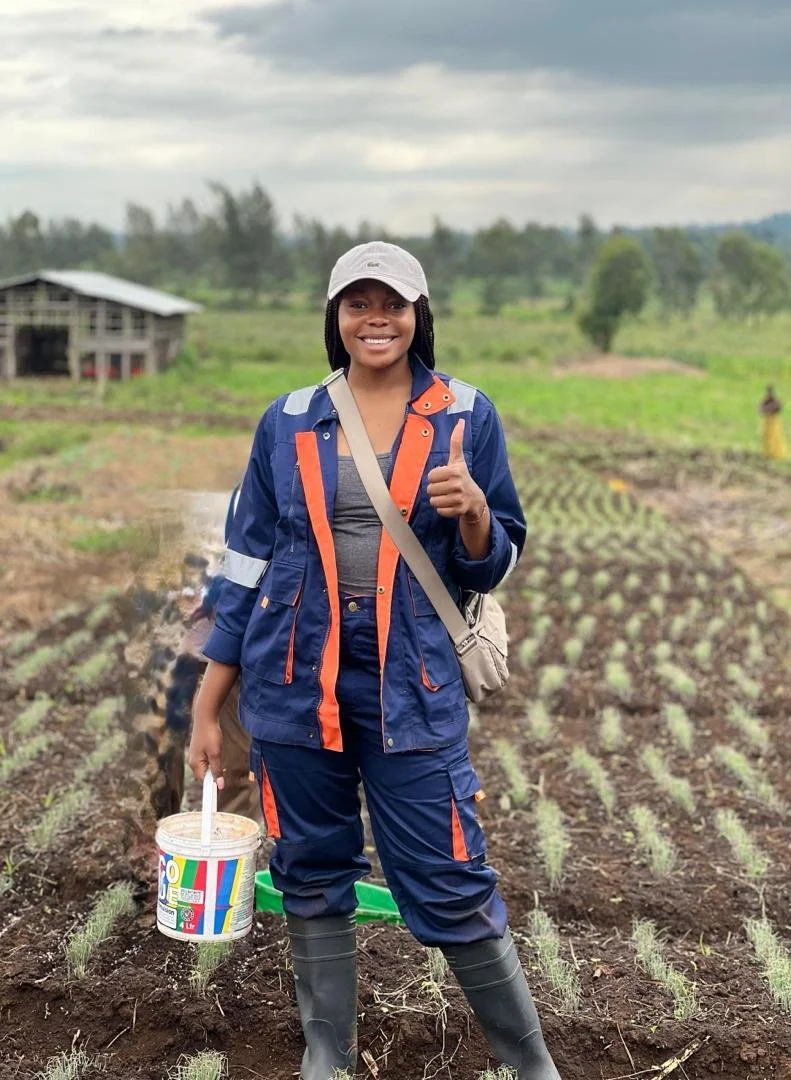
Blessing at work
Take action for these kids in Congo:
Share this post with one person you think may not know about the Congo Peace School
Read or listen to the four minute news report here.
Call your representatives and let them know you want the U.S. to take more action to end Rwanda’s support of the M23 and their takeover of Congo and its minerals. (Read the latest DRC News Monitor from our friends at PAEMA to learn more about the latest news from Congo.)
Host a baking party for a sale or dinner party in which you read about Congo and talk about our connection with the people there.
Donate – your gift helps us keep the doors open so these children can access a quality education rooted in peace, nonviolence, and equality, healing, curiosity, and joy.
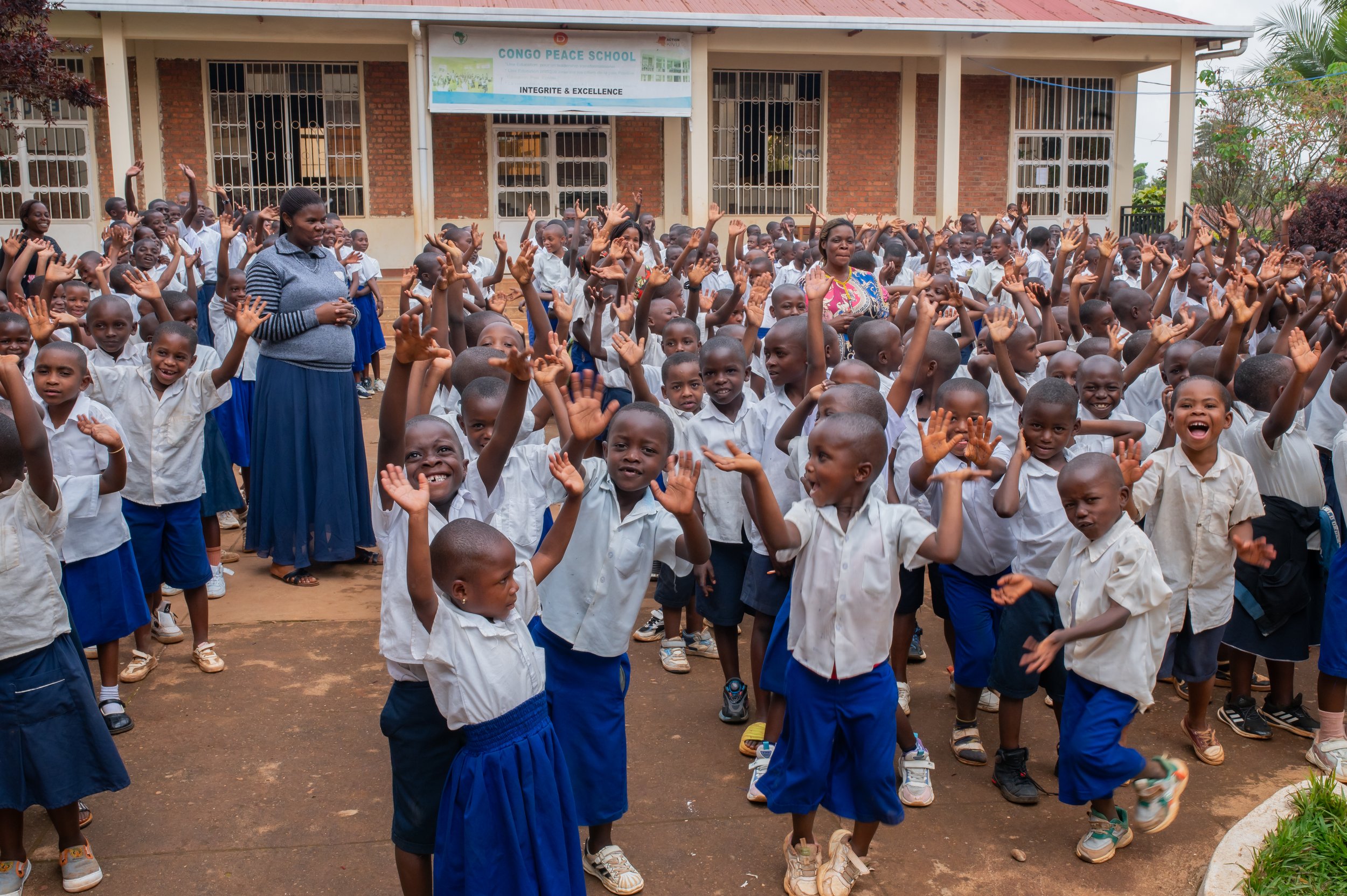
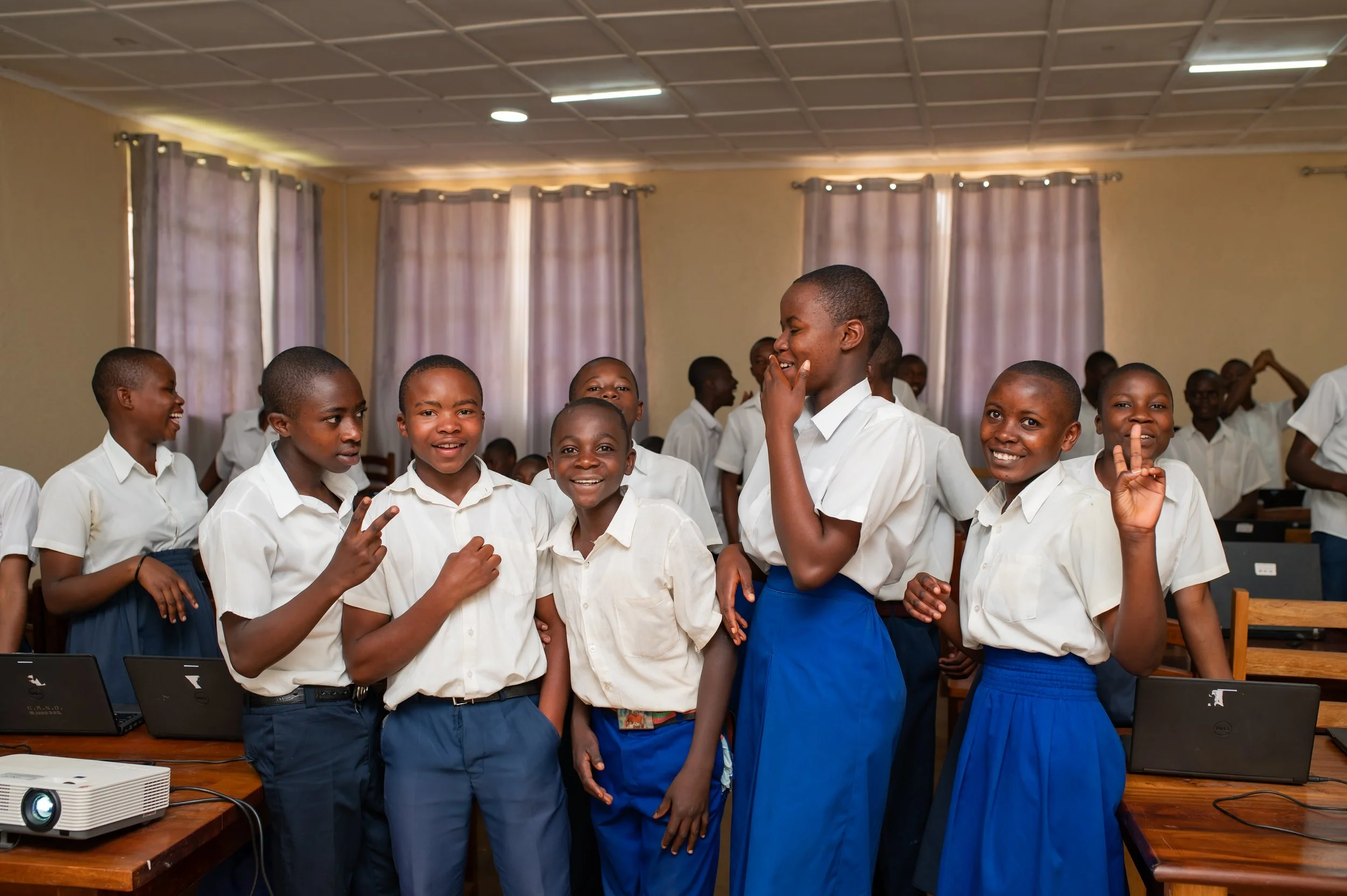
Amidst war, the Congo Peace School celebrates the class of 2025, and starts a new school year with song
Was there a moment in your life when you felt seen for who you might become? A teacher or parent or friend who gave you a word of encouragement, that in hindsight was a turning point for you?
When Amani Matabaro, our Founding Director and the visionary leader behind the Congo Peace School’s curriculum, learned the 2025 results of the national exams for the Congo Peace School students, he had a call with many of this summer’s graduating class. “I told them, some of you got better scores than I did when I took this test!” he said. “You could do more in the world than I have!” (A recent Harvard Fellow, speaker of many languages, trained in several studies around public health, pedagogy, and peace, Amani is a marvel in his own right.) I wonder, for how many of those students, that message will sink in and inspire them to overcome the obstacles that this world has unfairly placed in the way of the people of Congo.
I marvel at the mission of this school and its success thus far, thanks to your partnership, and the commitment of the teachers, staff, students, and community: to serve the poorest and most in-need children in that region, which, in the world, are some of the most overlooked and underserved children on the planet. 100% of the students in both primary school 6th grade and secondary school 6th grade (12th grade in the U.S.) passed, many with honors, while, we are sad to report, a majority of the students in the surrounding schools failed.
These are kids who sometimes take care of themselves when they’re not in school, orphaned and living with relatives who can barely afford to feed their biological children, let alone a niece or nephew.
These are kids who, with your support, now not only feel seen and loved, that their story matters, but also that their potential and possibility for learning and being leaders is endless.
Amani shared his thoughts in a brief video here, and, with the new school year (2025/2026) having started on September 1, sent a couple videos of the students stepping outside the classroom to sing and dance, including our preschool kids, supported by our amazing partner, Nest Global.

This, in the midst of war, where the campus is a haven of peace. (Scroll to the end of this post to read an excerpt from an earlier post about the safety protocols the school has instigated to best protect the students and staff as they decide each day it is safe to open the school.)
Amani highlighted one of the graduating class of 2025, Cubaka Germain, a great soccer player, Amani notes (Amani a proud footballer himself). Cubaka was an orphan who was in the Educational Assistance Program we started several years ago, before the CPS was built, with the support of many of you, our longtime partners, with Jewish World Watch, and with years of support from our community in Rhode Island. We started paying for Cubaka’s school fees in elementary school, before he transferred to the Congo Peace School.

Cubaka in primary school, before the Congo Peace School was built.
He just scored 76% on the national exam. (In terms of the U.S. GPA standards, this is graduating with honors.)
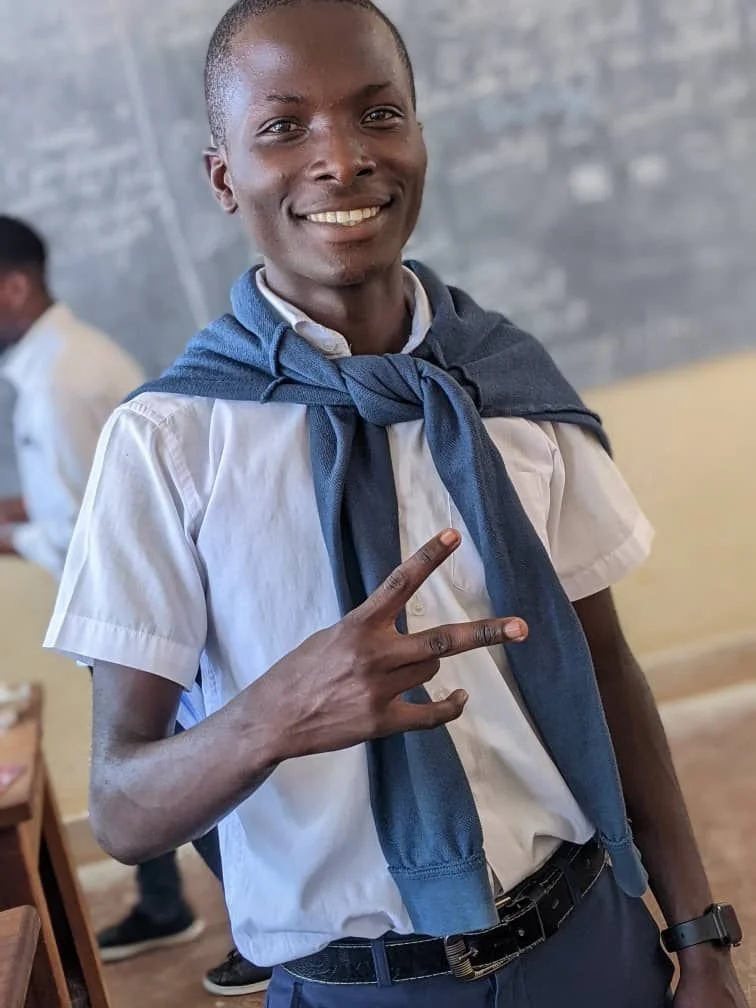
Cubaka, Congo Peace School Class of 2025
Denise Bora was also part of the Education Assistance program, and is now a brilliant high school graduate. She is pictured here alongside her fellow classmates, from left to right: Denise Bora (70%), Nzigire Pascaline (70%), Cynthia Hamuli (she graduated last year) and Ciragane Bitakuya Divine (75%).
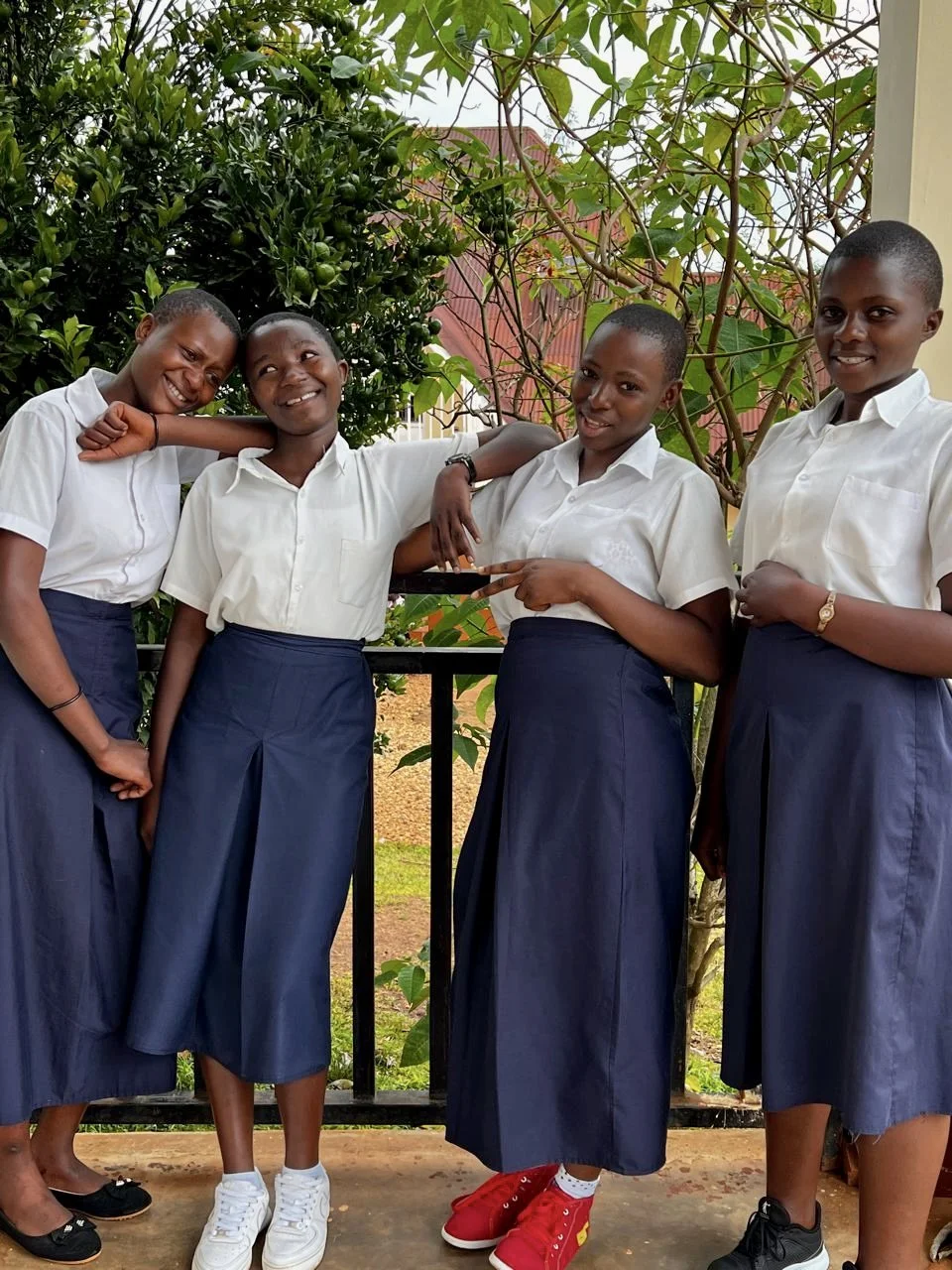
As Amani noted in the video, these children are amazing, and they did not accept war to take their dreams and hopes away.
In other Congo Peace School news, Blessing, one of Amani’s daughters, risked returning to eastern Congo to finish her university degree in agronomy, and is helping with the farm that serves the school as a teaching farm and providing some sustenance to support the meal program (though we need to expand on that in the coming years). One way to help keep kids in good health, especially to get a dose of potassium? Bananas. Blessing saw how the Chinese construction workers building the road had dumped dirt on the hilly portion of the farm, and suggested using the organic fertilizer created by the farm animals and compost to grow bananas for food production.

I hope, in the midst of so much terrible news of war and division, that these stories give you hope that a different path is possible. Peace within ourselves, within our relationship to each other and the planet, is possible.
Thank you for investing in this vision that is already becoming a reality in the lives of this community. Thank you for being part of the message to these students that others, people they have not met, believe in their beauty as humans and potential to thrive and lead, in whatever way that suits their unique talents and heart for the world. Asante sana!
To read more on the latest on the war, be sure to subscribe to the DRC bi-weekly news monitor from PAEMA, trusted friends in peace work.
In gratitude,
Rebecca, with Amani Matabaro
Rebecca Snavely
Executive Director, Action Kivu
(Below: the repost regarding the school's security protocol during war)
Déo, the CPS Secondary School Principal, shares how the Congo Peace School remained open most of the school year, when so many other schools shuttered for weeks due to the war.
“We have been shutting down only based on security assessment with our senior larger management team with guidance of the school founder, Amani Matabaro, who has experience with issues such as international humanitarian law, human rights, human and personnel security, and humanitarian ethics—it is not easy trying to manage all of these issues at this time.”
The Peace School posted banners with the information that read: “Schools, hospitals, and places of worship must be protected even during wartime. It is an obligation of international humanitarian law” both inside the campus and on the outside wall for anyone passing to read.
Deo continued, “This war deeply disrupted us at the school and community levels, but we have been learning many lessons from it, including the resilience mechanism that we are developing each day. For example, every day before going to school we have to find out about the security situation in the area. There are many questions to ask: Is it safe to walk to school? Are the teachers and students safe? Is the school safe? And even when we would begin the school day, we were not sure how it would end. Such uncertainty creates constant fear because of the ongoing insecurity in the region.
“With the students, despite sometimes hearing gunfire from some corners of the campus, we had to remain courageous. We always tried to understand the situation before making decisions: either to let the students and staff leave school and return home before the usual time, or to keep them in class until the end of the day. The wall around the school has been very helpful in terms of child protection during these difficult moments.
With our Congo Peace School Founding Partner, the Dillon Henry Foundation
The Peace School remains open, a podcast rec, and more
Update from Congo Tuesday, March 11 2025, plus a podcast from Human Rights Watch that quickly and thoroughly sums up the history of the recent and current wars between Rwanda & Congo wars, and ways to use your voice (or keyboard) to help ring the alarm. Read on:
The Congo Peace School (CPS) is open and its activities have resumed as usual.
Clean water is running into the campus, burbling from the nearby reservoir through pipes and taps the community helped build and into the cups the students drink from. It’s filling the sinks and flush toilets that allow them a healthy day without the threat of cholera.The teachers and staff are trained in recognizing signs of trauma, and when a student needs care, there are counselors to visit, safe places to rest.
We learned of eight young children in the area - not CPS students - who have died from malnutrition, as their families’ sources of food and small amounts of income were looted by soldiers from all sides of the conflict as they moved through the villages, and we will be assessing how we can provide food and resources.
Yet another challenge from the M23’s invasion is the soaring cost of food and supplies. Humanitarian aid is being restricted along many routes. Humanitarian aid itself has also been decimated by the Trump administration canceling of many USAID contracts and firing staff, ending the jobs of the people responsible for ensuring the most vulnerable among us have access to food, medical supplies, vaccines, malaria treatments, the list goes on and on. Additionally, the various factions of fighters all looted food and small businesses as they ravaged the land.
The Congo Peace School and Amani’s nonprofit ABFEC staff are assessing what is available to eat from the school’s farm and the community farm that Action Kivu supports outside the school budget. That farm also acts as the teaching farm for the students as well as providing plots of land for community members to grow their food. Over the years, it has expanded from growing cabbage and other vegetables to raising tilapia fish in three small ponds, as well as training staff in animal husbandry to provide manure to enrich the soil. In a few weeks time, there will be enough cabbages harvested to feed the school’s population for two weeks.
The fact that everyone is finding creative ways to support each other and continue providing this world-changing education rooted in peace and nonviolence is a testament to the shared belief in the mission of the school. Together we can create peace within ourselves, our classrooms, our communities, our cities, and our countries. We can lead with love and respect for every person, regardless of where they were born, the color of their skin, or how much money they have.
You are a part of this. Thank you.
Boats are once again traversing Lake Kivu, and the school staff is talking with suppliers about how much bulk food will be available for purchase and what the cost is now.
UN update: This afternoon (11 March), Security Council members met in closed consultations to discuss the situation in eastern Democratic Republic of the Congo (DRC). France, the penholder on the file, requested the meeting. Under-Secretary-General for Peace Operations Jean-Pierre Lacroix is expected to brief Council members on his 27 February-1 March visit to the DRC, where he engaged with Congolese authorities on the security situation in eastern DRC. His visit also included discussions on ongoing diplomatic and political efforts aimed at achieving an immediate cessation of hostilities in North Kivu and South Kivu provinces. Lacroix’s visit followed the adoption on 21 February of Security Council resolution 2773, which demanded the immediate cessation of further military advances by the Mouvement du 23 Mars (M23) rebel group and called for an immediate and unconditional ceasefire. (Read the full release here.)
It is maddening to not be able to stop the violence, but we are not helpless. Please continue to share stories with your circles of friends and colleagues, and can ring the alarm bell to amplify the voices of the people of Congo (and Rwanda) who do not want war, but want to live peacefully as neighbors.
This Human Rights Watch podcast entitled Congo: The Real-Life 'Vibranium' Wars, March 10 2025 is excellent, concisely hitting key points of the history of the current conflict and wars between Rwanda and Congo, and a great one to share with folks who know little about the current conflict. It notes that “in May last year, the M23 seized control of the Rubaya mine, one of the world's largest deposits of coltan.” Lewis Mudge, the Associate Africa Director at Human Rights Watch, stated: “They're carving out roads from Rubya straight into Rwanda.”
If you read a report or story that does not mention the role played by conflict minerals / critical minerals, you can send a letter to the editor, and reference points from this Reuters piece. It was reported in late January 2025, and since then, M23 has also taken Bukavu, South Kivu, and territory in and around mining concessions throughout North and South Kivu. If you look at the following map detailing the minerals in different areas of eastern Congo, and then look at the areas Rwandan-backed M23 fighters have taken or are fighting in, the strategy is clear.

List of cities / territories the M23 has taken control of / is currently fighting in, as of 11 March 2025
The Rubya mine is already under control of the M23 and they are exploiting coltan there.
The Luwowo mine is near the Rubaya mine and it is under control of M23.
In the Kalehe territory (South Kivu) the M23 has control of the Numbi mine and the region’s secondary mines such as (Fungamwaka, Lumbishi, Ngungu, Misumari). They are exploiting coltan as well as tourmaline (a rare gemstone)
The Kalimbi tin mine is in South Kivu, in the Kalehe territory near Nyabibwe, and is under control by the M23.
In the Walungu territory, M23 made a quick move to the Mukungwe and Nyamurhal gold mines; they are still fighting. On Sunday (March 9th) several people were killed by M23 in Walungu. As of Monday (March 10) M23 has taken control of the city of Nyabyondo, in the Walikale territory known for the abundance of critical minerals including tin, tungsten, tantalite, gold, and lithium. Walungu is on the way to the Mwenga territory, known for its abundant reserves of gold.
On Monday (March 10th) M23 advanced to Kaziba where there is a huge gold company nearby called Twangiza gold mine, they are still fighting over there.
The road to Uvira is not only to control the city but to make an easy move to the Fizi territory in order to control several gold mines there.
Call your representatives. Governments are starting to put pressure on the Rwandan government to stop funding M23. Encourage them to keep doing so. Demand a ceasefire and peace talks. The Congolese government needs to be held accountable for its years of poor governance for its people as well. The people of Congo deserve free education, paid work, working roads, healthcare, and clean water. This is a time to stand for and speak up to power for the people of Congo. In the U.S., you can find your representatives here: https://www.congress.gov/members/find-your-member
Share stories: Remind friends and colleagues that these kids are who we are fighting for, for these children to grow up safely and be our future leaders, emboldened with the knowledge of and practice in nonviolence, equality, and healing from trauma.
In that HRW podcast, the host's father is one of the Congolese people he speaks to, and it is heartbreaking to hear him reflect on how many people have died from the wars in Congo (over six million) and that "nobody in the world – excuse me the word - gives a damn. Nobody cares."
Thank you for caring, and your ongoing commitment for peace in Congo, Africa, and our world. If you'd like to support Action Kivu's work in creating safe spaces for equality, nonviolence, and peace education to take root, please donate here.
Update from Congo War: The dam breaks, and what a barrage looks like
“The M23 rebels on Sunday captured Bukavu, a city of 1.3 million people, after seizing Goma, 101 kilometers (63 miles) to the north last month. At least 3,000 were reported killed and thousands displaced in the Goma fighting.
“The M23 is the most prominent of more than 100 armed groups vying for control of eastern DRC’s trillions of dollars in mineral wealth that’s critical for much of the world’s technology. The rebels are supported by about 4,000 troops from neighboring Rwanda, according to UN experts.” – excerpt from CNN report
The Peace School has not been attacked, and remains closed for safety. M23 has control of the region, and there are reports of gunfire and bombs. Our security guards know they can leave any time they sense threat, but thus far they have stayed, and reported that military members of Congo’s army (FARDC) showed up and asked to be let into the campus. They scoured the campus and left without taking or damaging anything. I picture heavily armed soldiers staring at the school’s walls that are filled with art and messaging about nonviolence and how to practice peace and forgiveness, and my mind reels at the irony. My mind rages at the idea of this beloved place built for peace to be filled with the weapons of war. Some of the faces of the folks who built the Peace School, from my visit in 2018:

photo by Rebecca Snavely
Many people in the area have had homes and small businesses looted. Many have fled the gunshots and bombing.
We were sent this photo of two little boys, and the report that the Congo army had outfitted and armed them as soldiers. That they had been killed by M23 rebels. The UN is investigating the M23 summary execution of children in Bukavu (PBS Newshour story here).

My dam has broken, I texted Amani. I’d been able to hold back my sobbing, to try to focus on facts and calling representatives and what to do next. But now, when someone asks how my day is, my dam breaks. Walking around our local park, watching kids play and kick soccer balls and cry out to each other, my dam breaks.
My dam had been built of moments of dissociation, not allowing myself to picture the individual students and staff members and families I’ve met over the years in Congo. But knowing that soldiers’ boots had wandered the auditorium where our young peace ambassadors gather to read in the library, to recite poems and perform plays they have written, broke through my walls. Knowing that the playground and basketball court are no longer filled with the cheers of children broke into my resolve.
The tears that pushed through the dam are for Anouarite, who was orphaned and thus had no one send her to school (public education in DRC is *supposed* to be free, but often the teachers are not paid, and the families pay out of pocket). Anouarite was so determined to get an education that she joined Action Kivu’s adult women’s literacy class before the school was built. I was visiting during the final stages of construction in 2018, and noticed her amongst all the grown women in the adult literacy class, and learned that Anouarite was 10 years old. As Amani and I started to say our goodbyes, Anouarite stood up and addressed Amani. Barely four feet tall, she stood strong and confident and asked if she could attend the Congo Peace School when it opened in September. Amani said yes on the spot, as part of the criteria to select students is to find those most vulnerable, who have no one to look out for their education, as well as to find strong leadership potential.
As we celebrated her drive and determination to get an education, she interrupted: "But I have no uniform." Amani assured her that the uniform and supplies are part of the school, and she would be well cared for. (Anouarite’s story here)

Anouarite pictured in the right front of top photo amongst the women of the adult literacy class, and jumping into the aisle of her first grade class two months later. Photos by Rebecca Snavely
One of the women who make those school uniforms is Ernata, who has survived years of trauma and loss. After graduating our Sewing Workshop training, Ernata started her own sewing business and began training other women. I first met her in 2011, and remember how strong her clasp was on my hand as we posed for a photo. Every time I visit, I see her and am inspired by the life she has created for herself, her children, and those around her.

Ernata in her workshop, 2023. Photo by Rebecca Snavely
I think of Benjamin, and his smile and warmth. Benjamin is Amani’s right hand man who knows everyone in the community and arranges our home-visits, calling ahead to make sure folks are there so we can hear about their lives. Benjamin, who saw his brother killed in the previous Congo wars, and who is a skilled photographer, untrained but with a natural eye for composition.

Benjamin in front of the chalkboard in the Peace School’s computer lab, 2023. Photo by Rebecca Snavely
I think of Rosalie, one of our first graduating class, who is now in university and determined to do all she can for a peaceful world. I think of the looks in the eyes of the children as they practiced a new art form, and shaped new realities in clay, artists all.

***
Reports from the field
Monday, February 17:
· As M23 has conquered the city of Bukavu, today they moved southwards to Mumosho and Nyangezi Road #5, many DRC and Burundi troops had set up a road block in the Mumosho / Nyangezi area where heavy fighting took place with bombs and heavy artillery. Many people were forced to flee their homes in both Mumosho and Nyangezi. The M23 -RDF (Rwandan Defense Forces) coalition are visibly armed with advanced technology equipment and using drones for surveillance and localization.
· There are reports coming out of Burundi to be verified, that youth from Congo who moved there to study or fled there from the war are being gathered and commissioned into armed service to be sent back to fight in Congo.
Tuesday, February 18:
· The strategic city of Kamanyola on the border of Congo, Burundi, and Rwanda has just been conquered by the M23 rebel group. This will make it easier for Rwanda to deploy troops into Congo.
· Burundi’s army is withdrawing from Congo. Burundi has had troops in eastern DRC for a number of years to primarily fight rebels stationed in Congo and intent on conquering Burundi, but since the beginning of this escalation of war by M23, Burundi had been aiding DRC troops to fight M23. They appear to be withdrawing to defend their own country. (Reuters report here.)
· Cases of Mpox and cholera are on the rise in the camps of the people displaced, as they are denied access to clean water and supplies.
· The Red Cross is recovering bodies from Bukavu, the number is not yet fully counted but was at 26 on Tuesday the 18th. When M23 captured Bukavu, the FARDC had not engaged in battle, to spare civilian lives in the crowded city. (A video of the busy market area from my last visit in 2023.)
Thursday, February 20:
· M23 is approaching Uvira, which is located at the intersection between Bujumbura in Burundi, and the city of Kalemi. If they capture Uvira, it becomes very easy for the rebels to control the southern part of South Kivu, and also to advance to Kalemi, a strategic city as it opens the roads to Lubumbashi, the capital city of the mineral-rich province of Katanga.
***
It is difficult to express the depth to which the chaos and terror reaches. So many people want to help those who are suffering, to send food and supplies. Banks are not safe to wire to, and when we can, we will be wiring to our colleagues with mobile banking. But currently, in Goma and Bukavu and surrounding areas, it is not safe to go out to purchase the food / supplies and then distribute them. We have reports that M23 are targeting key civil society and NGO leaders, thus, it is not safe to gather in groups or move freely to buy and distribute food, even if there is food and supplies to distribute.
Your donations to Action Kivu will be life-saving. As soon as it is safe to do so, the school will resume classes and meals. The need for the greater community will have increased, as so many have been without access to food or work for so many days, and we will determine how we can help meet those needs. We partner with a trusted local NGO in Goma, and we will also be looking for ways to distribute food and supplies there as well.
When I wrote “my dam is breaking” and let the tear flow, I looked up what the word dam translates into in French, Congo’s language of colonization and the one used in education. It is barrage. My first understanding of barrage as we use it in English is actually flow, not stoppage. A barrage of, well, tears. A barrage of letters arrived at the capitol. Merriam Webster’s first definition of barrage as a noun is : a dam placed in a watercourse to increase the depth of water or to divert it into a channel for navigation or irrigation. Number 2 definition is what I’m more accustomed to using: a vigorous or rapid outpouring or projection of many things at once
a barrage of phone calls
unleashed a barrage of insults
an oratorical barrage
As I think about my personal barrage breaking, I want to embrace the version of barrage that is needed right now. An outpouring.
An outpouring of love and community building and raising awareness, please share the news stories about the war, and the individual stories of our beloved community in Congo.
An outpouring of calls to your representatives: that we are outraged this is happening. That they must pressure the presidents of Congo and Rwanda (and the other bordering countries) for an immediate ceasefire, and a transparent supply chain of minerals that are sourced in Congo (especially those needed for our technology and green energy future, cobalt, gold, and the three Ts: tin, tungsten, tantalum. (Read more about conflict minerals here.)
Corruption flourishes in darkness - the more people aware of what is happening in DRC and crying out for peace, the more pressure on the leaders of the countries to comply with the rule of law and justice. The leaders of DRC must also be held accountable for the corruption over the years, a rich country populated by people living in extreme poverty with little access to work, food, clean water, or education.
The CNN article linked above states it clearly: The M23 is the most prominent of more than 100 armed groups vying for control of eastern DRC’s trillions of dollars in mineral wealth that’s critical for much of the world’s technology. And the people of Congo suffer.
We are grateful for your attention on this barbaric war, rooted in greed and power, that is crushing the people of Congo. The need for the Congo Peace School’s teachings of nonviolence and peace within ourselves and within our communities and country are never more critical than now.
In solidarity,
Rebecca, with Amani’s reporting and review
Read more, including more history of the relationship between Rwanda and DRC: https://www.bbc.com/news/articles/cgly1yrd9j3o
Sanctions from the U.S. Treasury on February 20, 2025
—
Rebecca Snavely, Executive Director
Action Kivu
UN Report on Children in Congo & MLK’s Nonviolence Principle Three - Oct 2023 at the Congo Peace School
"There are few worse places, if any, to be a child."
While we love to share the amazing impact your giving makes in the lives of the children and adults we partner with in eastern Congo, we also know it is important to share the horrific context in which these children we serve are not only surviving, but thriving.
As noted in the September 2023 press briefing from the UN’s children’s agency UNICEF on Congo (DRC) and specifically the eastern part of the country where we are located, “the war-torn country had the world's highest number of UN-verified violations against children in armed conflict.”
The violence "has reached unprecedented levels," said Grant Leaity, UNICEF's representative in the country. "There are few worse places, if any, to be a child."
“The east of the Democratic Republic of the Congo (DRC) is facing one of the world’s most complex and forgotten crises. Around 2.8 million children are bearing the brunt of violent conflict, being recruited by armed groups, losing their families and homes, and being exposed to ever-growing levels of sexual- and gender-based violence.” (ReliefWeb infographic here)
It’s a harrowing and difficult report to read, a content warning for sexual assault and violence against young children.
In this space where so many use violence to control innocent civilians, our Founding Director Amani Matabaro’s vision for active peace is revolutionary. Each week at the Congo Peace School, the students and staff focus on a principle of peace and nonviolence as taught by Martin Luther King, Jr.
This last week the focus was the development and interpretation of Principle Three of Kingian Nonviolence: Nonviolence Seeks to Defeat Injustice, or Evil, Not People.
Training the teachers, Amani helped them put the concept into vocabulary that is easier for the students to understand – to attack the forces of evil, not the persons doing evil, so the students and staff could focus on how to practice the principle in the context of eastern DRC.
Amani spoke to some of the Peace School students to ask how they understood the principle, and how they are putting it into practice in their own lives.

Amani’s respect for the students and treating them as equals has created so much joy in their interactions.
Anouarite Zirhumana joined the Peace School when it opened in 2018. An orphan, she had no one to send her to school, a common story of out-of-school children in Congo (in DRC public school *should* be free, but the teachers are typically not paid, so families must pay monthly school fees in addition to the cost of uniforms and books). Determined to learn, she had joined the Adult Literacy Program provided through Action Kivu’s funding, and when she learned about the Congo Peace School, she bravely asked Amani if she could attend. Six years later, in the 6th grade, she shares what Principle Three means to her in practice:
“If someone makes a part of the school dirty, we do not beat, bully or attack that person, we quickly clean that place and ask the person not to do it anymore.”
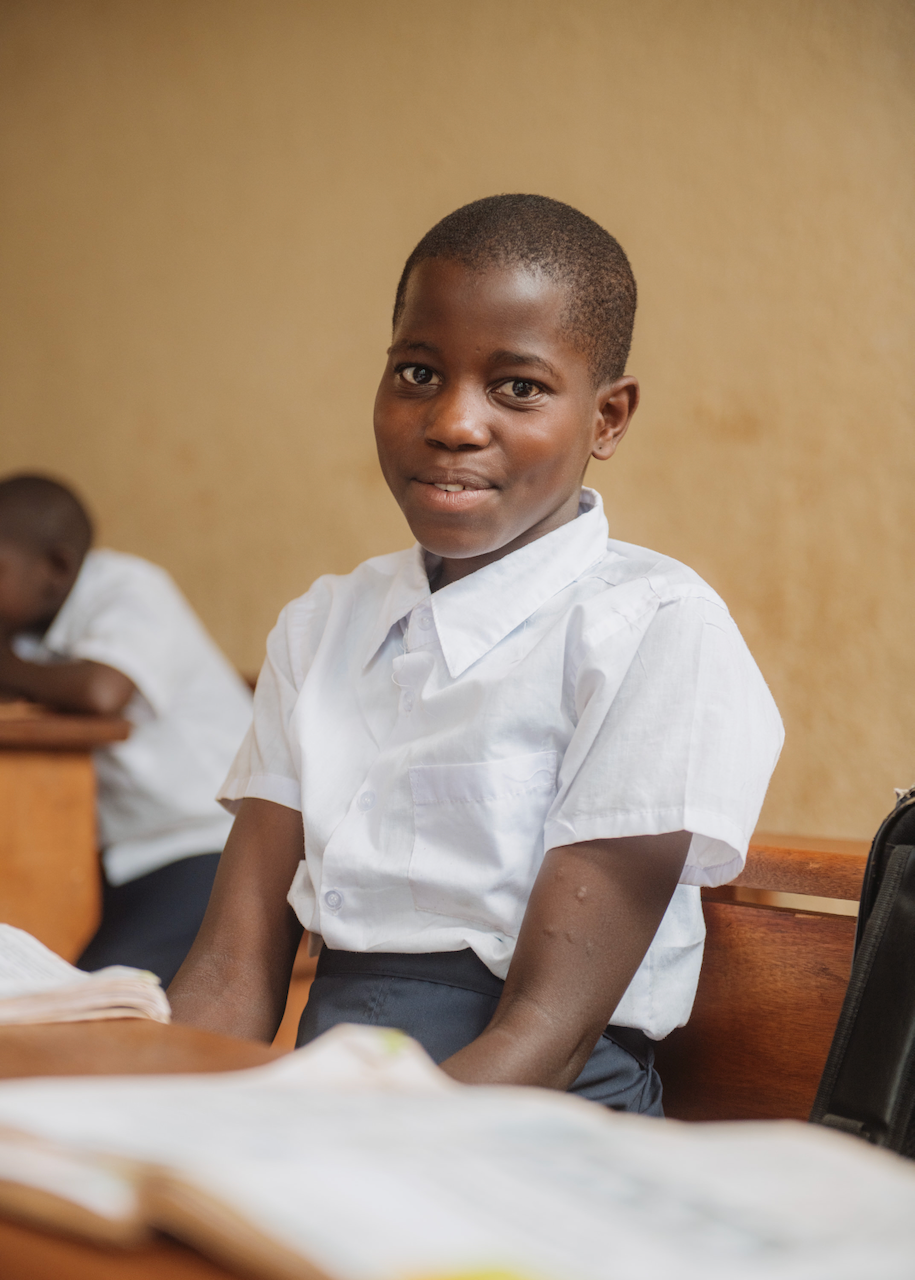
Justin Mushamuka: First grade secondary school (7th grade in U.S. system):
“Understanding Principle Three, it is clear that people can defeat injustice, and let justice prevail in our families, communities, and societies. For example, if there are people who do not respect equality between women and men, we do not need to attack them, but simply put equality in action. The representative of the entire Congo Peace School student body is a girl, it should not always be a boy.”
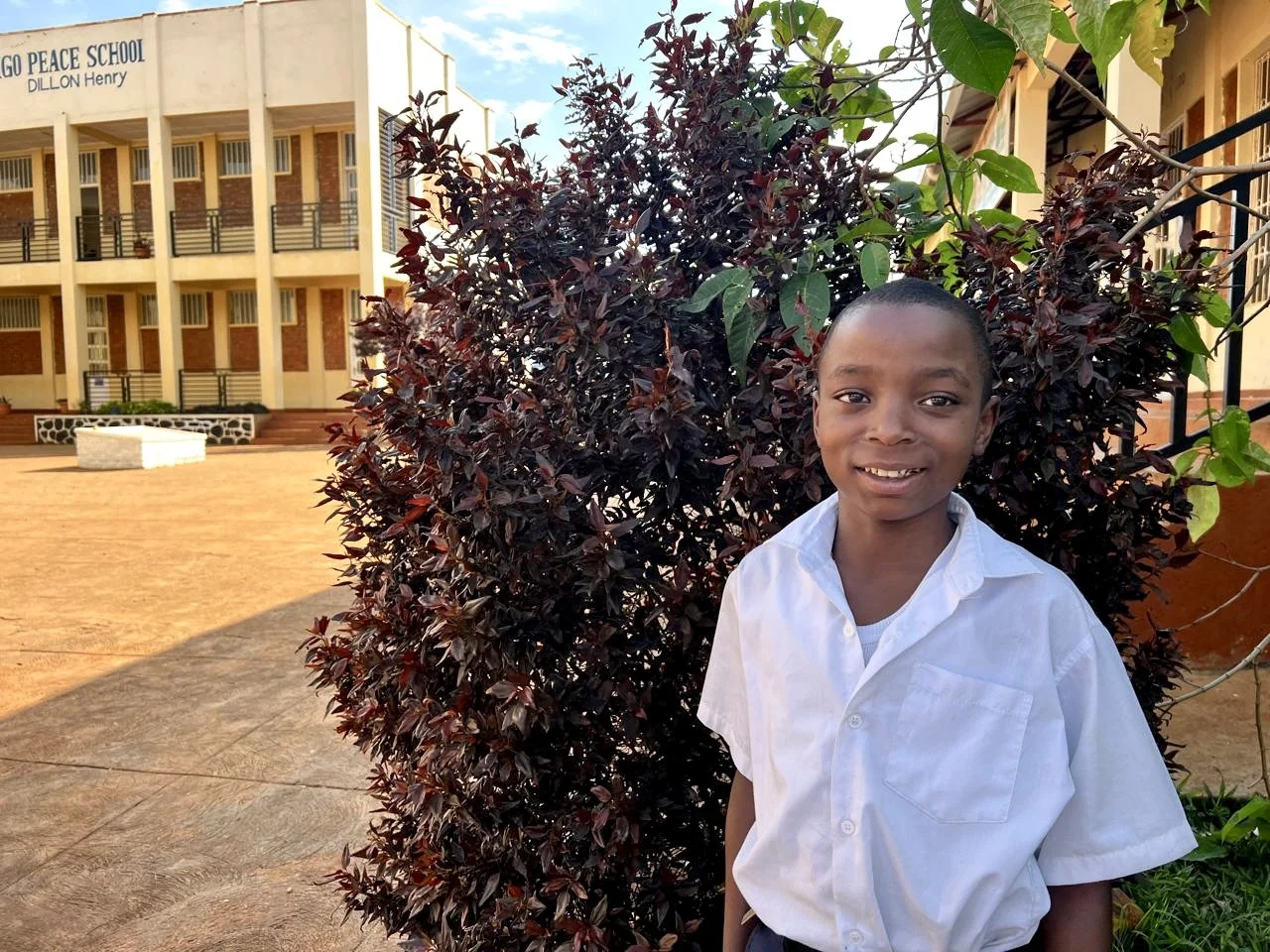
Ajuwa Masumbukao: Second grade in secondary school (8th grade in U.S. system)
“My favorite example of the use and practice of Principle Three in recent history is what former President Mandela did in South Africa fighting apartheid, not the people doing it and the result is that reconciliation was possible to build the South African nation.”
Kabika Bacirheba: Second grade in secondary school (8th grade in U.S. system)
“Principle Three means that people need to attack the root causes of the problems and not individuals doing the problems, otherwise injustice will continue on and on.”

Kabika’s statement truly sums up what happens if we don’t embrace Principle Three – if we only attack those people committing evil, the roots of the problems remain, and the cycle of violence continues. The people doing evil acts are part of a system of evil and injustice. How can we attack the root causes? In DRC, they are myriad, but many stem from a history of colonization and corruption and the theft of DRC’s minerals, mined by Congo’s people, women, men, and children who are often enslaved or paid a dollar a day, people who don’t reap any of the wealth that leaves their nation, and then powers the world’s electronics. Deep food insecurity and resulting malnutrition is exacerbated by militias fighting to control mineral-rich areas. Children die before they have a chance to change their world from preventable diseases such as cholera.
As it is not located in a mining area, The Congo Peace School is in a place of relative peace, but the students and staff and community are surrounded by the violence of militias and war, the threat of being recruited as a child soldier, and the extreme poverty that leads to malnutrition, child marriages, and gender-based violence.
From the UNICEF summary of remarks: “In the first three months of 2023, in North Kivu alone, more than 38,000 cases of sexual- and gender-based violence were reported. That’s a 37 per cent increase compared to the same time period in 2022. Said another way: in just one year, there have been 10,000 additional reports of sexual- and gender-based violence. Those are the ones reported. And in North Kivu alone.”
“As well as unprecedented levels of violence, the lives of children in eastern Congo are threatened by epidemics and malnutrition. Around 1.2 million children under five in the east are facing the risk of acute malnutrition.
UNICEF’s Leaity warned about the risk of "acceptance of something which is unacceptable."
"As the world looks away, we are failing the children of DRC," he said.
As partners in the Congo Peace School and Action Kivu’s other community-based projects, you are some of those who are not looking away. Together we are attacking the root causes of injustice through investing in education rooted in peace and nonviolence, providing practical resources for a different way to live in harmony with the planet and with one another. The students eat well and learn not only about nutrition, but how to grow healthy food with regenerative farming. An educated population will better understand their rights in elections, like the presidential one this December.
We’re also thrilled to share the news that Books for Congo just sent over 3,000 books for the Congo Peace School library – sourced in French and many from African authors – according to the list the school gave the organization for the needs of the library, from literature to the sciences to mathematics to social studies and languages from pre-K to adult level. The school’s wide selection of books opens the world to the children, staff, and their families.


Amani sees a direct impact of this unique access to books in the success of the students in their national exams as compared to other schools in the region. We look forward to sharing this access with the community and other schools in the region as the school begins a community access plan for the library, previously unseen in the area.
Take more action and share this post! We are actively fundraising to meet the school's budget this year and next and continue to fund our adult education, community health, and regenerative farming projects - help us grow our community of partners by sharing about this revolutionary and transformational work.
If you're not a monthly or annual donor, please consider a gift to support the children of Congo today.
Thank you for caring for the children of DRC and stang alongside them in imagining a different and peaceful future.
New Videos: Congo Peace School 6th Grade Graduation, Preschool Student, and Students Reflect on Art
This past summer the Congo Peace School offered an art course, taught by volunteers from a university in nearby Bukavu. Before this unique course – a rarity in a region where many of the children’s families can’t afford a pencil and paper, let alone paints – we asked four of the students to define what art means to them. And now we follow-up with them, after they have completed the course.
Before: 6th grader Ambika had said, “Drawing, painting, and that’s it.” Ambika signed up for the art class to learn more, to discover new things.
After: “I had no idea children of our ages could learn and achieve what we achieved during the art class. When we started learning how to draw using a pencil, I had no idea we were to do more. When we started shredding the papers I was a little bit disappointed but when we started making dough from waste paper, it gave me hope, but I could not have imagined we would be able to achieve making a flamingo. The day we made it, I loved art more and more and can't wait to be in another summer class and learn how to achieve more. Now I know that art is everything, it's more than drawing and painting: art is an expression and can be used in many ways.” – Ambika

Before: Fellow 6th grader Mushagalusa had said, “I think art is just drawing and I very much like to draw. I signed up for the art class because I am curious and want to learn. This is exceptional, no other school has a formal art class, I am lucky and happy to be a student at the Congo Peace School. There is no other way I make art apart from drawing at school but nobody teaches you, you have to do it on your own.”
After: “After our summer art class, now I know that art is not only about drawing at school, but also more than that. It's a very complex area, it's many things at a time, someone can communicate and speak through art, and it can be used to express or demand peace. I am very proud to have achieved this dove as a symbol of peace that our country is hungry for.” – Mushagalusa

Before: 4th grader Nsimire had simply said, “I had never heard about art before. I want to learn and discover. I like colors.”
After: ''I discovered art and I like it, now I know that it's a combination of many things coming together to achieve one thing like the fish we were able to achieve as a group. I am very curious to learn more next summer.'' – Nsimire

Before: Agisha had defined art as “using pencil and color crayons to draw or paint or write like on the walls of our school.* But I didn’t know children like us can do art. I signed up for this class to learn art.” (*The school has murals and quotes around the campus.)
After: ''It is very amazing, it makes me happy to see children like us being a part of this process. From simple pencil drawing to cutting paper, then putting them together and making the ‘dough,’ mixing it with paint and then come up with a lamp! I had only been seeing these things in books here at our school. I am very excited about achieving more during the next summer art program. Why is there no art class in the school curriculum?'' – Agisha

You are part of this joy-inducing, life-giving community! A big thank you to everyone who gives monthly or annually to support this unique school that is creating equality and peace from the inside out.
Currently the Congo Peace School’s powerful curriculum rooted in peace and nonviolence is funded by our community of donors and foundation grants to the level that we often employ art as therapy, but we want to change the answer to Agisha’s last question and sustainably expand the offerings, including art and other vocational trainings. Please share these stories with friends and family to help us grow our community of support.
⚪ As the new school year kicked off in September, the Congo Peace School celebrated the graduation of Grade 6 students into Grade 7 (or 1st grade secondary, as it is known in DRC). This ceremony was the first of its kind in Mumosho, and rare in South Kivu and Eastern Congo. The gowns were made by many of the graduates of Action Kivu’s Sewing Workshop – just one illustration of how our programs build upon and support each other.
Family and community members gathered to celebrate the special day. Please watch the video with the volume up to celebrate with these students who all passed the nationwide standardized test to graduate into secondary school!
The sense of self-worth this helps provide is priceless. Thank you for investing in the lives of so many in this way.
⚪ The Nest is the preschool at the Congo Peace School – three classrooms supported by our partner PILA Global in fostering curiosity and a sense of agency in the students ages 4 to 6 years old, preparing them for elementary school where they are encouraged to question and think critically, unlike so many schools in the region.
Amani shared the following video with the notes: Marcelin Murhula is a 5-year-old Congo Nest student who demonstrates remarkable oral communication skills, initiative-taking, sharing his thoughts, and thinking critically.
In the video, Marcelin is speaking correct French (the official language of education in DRC, and the third language citizens learn, after a local dialect and Swahili). Here he is talking about his school, saying: ''our school is called Congo Peace School. It’s beautiful, it has three levels: preschool, elementary, and secondary. We have amazing caregivers and teachers, they teach us reading, writing, and numeracy. May Congo Peace School live long!”
⚪ Lastly, we just finished a new video that highlights so much of what is special about the Congo Peace School – please watch and share!
With gratitude for your continued partnership and drive to create a more equitable, just, and peace-filled world.
Rosalie's Story & Charlene's Studies (March 2022)
“The present changes the past. Looking back you do not find what you left behind.
”
In our fourth year of the Congo Peace School, we see that some changes are gradual, and some are seemingly instant. More gradual is the deepening understanding of how the practices of peace, nonviolence, and equality affect one’s life, family, and community, while some changes are immediately visible, like the change we witnessed in Rosalie from July 2018 to September of that year, and now, four years later, in her leadership at the school.
In July 2018, Rosalie and her brother came to the school while it was still under construction. They had recently lost both their parents to AIDS, and were naturally devastated, and in shock and grief. Amani immediately enrolled them in the first year of the Congo Peace School, promising them everything that entails, daily meals, uniforms, and access to the nurse and the school counselor, trained in psycho-social techniques.
When I returned to the school only two months later, shortly after we opened in September, 2018, I didn’t recognize Rosalie. She smiled, she posed for her portrait with confidence, and told me that she dreamed of using her education to be president of Congo one day.
Now, Rosalie is in the 5th grade of the secondary school, and acted as the student representative for the International Women’s Day gathering held this March at the Congo Peace School, where the students, staff, and community honored the progress made and challenged each other and the world to work harder for women’s equality and equity.
Speaking to a room of fellow students and adults, Rosalie concluded her speech on leadership by the following words: “Dear friends, brothers and sisters, we all have to understand what leadership is all about, a leader is someone who is able to inspire, guide. … You are a girl, you are a woman, do not underestimate yourself that you cannot lead a group. My wish is that the DRC’s next president is a woman and maybe through a woman DRC [Democratic Republic of Congo] will change, that is what I wish. Thank you.”
Photos of Rosalie and her brother in July 2018 to her the first semester of September 2018 to now.

Rosalie & brother, July 2018

Rosalie, September 2019

Rosalie, March 2022
As we continue to work with students in a trauma-informed model, we are excited to share that our Founding Director Amani Matabaro’s eldest daughter Charlene is back in Congo and volunteering at the Peace School after graduating from Hope International University in Fullerton, California this past December (2021) with a degree in Psychology, Counseling and Child Development.
Having been away from Congo for over five years, Charlene shared, “In my mind, I was coming back home to rest, spend time with my family, friends and above all, I was excited to visit the Peace School.”
“The week I arrived,” Charlene wrote, “I went immediately to discover what the Congo Peace School really is. I drove 50 minutes from Bukavu, my hometown, and upon arrival I was amazed by the building and how clean and green the school is.
“I was curious to see if the same beauty and greenery were also in the hearts of the students, teachers and the community around the school,” Charlene shared. “I was interested in discovering the school has a dispensary where children and teachers get some first aid assistance, the school has a cafeteria where they take lunch and a light breakfast every morning. This is unlike almost all other schools in the entire country.
“I went deeper to see how the school children were doing as far as their mental health is concerned and to see if they needed social support.”
Charlene reflects on the trauma of living in Eastern Congo, where the threat of armed conflict creates instability and fear: “After speaking with a few elementary and secondary school students whose ages range between 6 and 18 years old, I started seeing and feeling the level of trauma among the children. I arrived at the school the same period of time when one of the preschool teachers was returning from hospital after she had survived an attack by gunmen, and she was shot in the face. The school children knew about it, and some children told me they are very much afraid because of what might happen any time to any of them.”
(Our preschool teacher Pascaline continues to receive treatment for the wounds on her face. The doctor is confident she will fully recover, but it is a slow process. Amani shares: This severe trauma Pascaline is experiencing is another reason why we need to keep raising our voices for peace and justice.)
Charlene continues: “Meeting and speaking to the CPS teachers and students made me feel there is a good reason why I went to Hope International University and studied Psychology, Counseling and Child Development – it’s exactly what my country needs. It needs healing while it also needs repair of the physical infrastructures, but I strongly believe that mentally and emotionally healed people can easily and quickly physically heal and repair their nations.”
Charlene has been working with the student body, teaching them group activities to access healing. We send a big thank you to Charlene, for using her skills, education, and compassion to help us all in the path to peace and healing.

Charlene with several students in one of the preschool classrooms supported by PILAglobal.
Speaking to students one-on-one, Charlene shares that 11th grader Samuel Mushagalusa is very motivated to read books. He shared that: "Growing up, I never saw a library in my entire life until I started school at Congo Peace School. We must do well in school because we have books. I wish I could meet some of our donors just to say thank you for what they do."
On behalf of student Samuel and his classmates, teachers, and all of us: Thank you! Your giving is changing the world in this visible, concrete way.
“Never doubt that a small group of thoughtful, committed, citizens can change the world. Indeed, it is the only thing that ever has.
”
More images from Tomaso Lisca's visit to the school:

CPS Computer Lab & Library. Photo by Tomaso Lisca

Amani teaches the practices of regenerative farming to CPS students. Photo by Tomaso Lisca
Hope in the Dark: One Student's Determination
When the entire world seems consumed by unnecessary trauma and violence, I find it difficult to write about hope, and turn often to Rebecca Solnit, whose work and writing is rooted in the investigation of human behavior, and hope in the dark.
““Hope is not a lottery ticket you can sit on the sofa and clutch, feeling lucky. It is an axe you break down doors with in an emergency. Hope should shove you out the door, because it will take everything you have to steer the future away from endless war, from the annihilation of the earth’s treasures and the grinding down of the poor and marginal... To hope is to give yourself to the future - and that commitment to the future is what makes the present inhabitable.””
Your partnership with the people of Congo is active hope – it is the daily practice of work that invests in a future led by people who have done the work to heal wounds and know the value of peace and equality.
Perhaps you also need a dose of hope today? Take a moment to look at Anouarite’s determination and joy in these photos and stories.
An orphan who had no one to send her to school, in 2018 Anouarite had enrolled in the adult literacy classes Action Kivu provides for women, and seeing the Congo Peace School built, was determined to attend.

Anouarite, pictured far right in the front row, eyes closed, with some of her Adult Literacy classmates in July, 2018.

Amani showing Anouarite a peace sign in 2018, after she asked him if she could attend the Congo Peace School when it opened.
Thus, when she enrolled in our first year in 2018, Anouarite was older than all her classmates. Her 2nd and 3rd grade teacher Salomé describes Anouarite as a highly committed student, quiet and intelligent, able to learn quickly, with enthusiasm. Anouarite enjoys writing and reading classes, and struggles more with mathematics. "She is an amazing student to teach and have in a classroom,” said Salomé.
Our Founding Director Amani Matabaro recently spoke to Anouarite, now in the fourth grade. “The beginning of the school year was challenging with all the sad news about the pandemic,” she said. “I was worried, but at this point I am not. This year I like being in school and I will be as long as the Congo Peace School can support me. I like teacher Jeanine and how she cares for all of us in the classroom, we are like her own children. Being in a school where I can get food, school uniforms, and medicine gives me a new hope for my future.

Anouarite in 4th Grade, Feb 2022. Photo by Tomaso Lisca
“My favorite parts of the school year so far was two weeks ago when we were told about the importance of tree planting and how they contribute to keep our environment healthy. I like all the writing and reading classes. I like reading and being with friends. The main challenges include not having food if I’m not at school, I have no clothes apart from my school uniforms. I need to learn more in calculations.”

Photo credit: Tomaso Lisca
In February, we had three interns from the Bukavu Higher College of Rural Development who are learning to put their theories into practice at our community farm. The students and staff also planted 400 Grevilea trees around the marsh farm, raised from seed to sapling! The trees bring more birds to the area, and the falling leaves provide good fertilizer mixed with our composting system.

Photo credit: Tomaso Lisca

Amani planting trees with Congo Peace School students, a community neighbor observes. Photo credit: Tomaso Lisca
A bit more about Anouarite’s teachers, as your partnership is also employing women, providing them the means to thrive in their careers, to be examples of women in leadership in their community, and to send their own children to school while bringing home the unique lessons of peace, nonviolence, and equality from the Congo Peace School curriculum.

4th Grade Teacher Kujirakwinja Rutagaya Jeanine is a CPS teacher with 10 years of experience in elementary school teaching. This is her third year at the CPS. Jeanine is a mother of four, two sons and two daughters.
"It is lovely having Anouarite as a student, Jeanine said. "She likes school, she has friends in the classroom, and is always ready to bring her classmates together when there is an argument. During classes, she asks a lot of questions in almost all the subjects, she makes lessons alive with interactions. She is very honest."

Salomé wears a Jewish World Watch shirt - one of our amazing partners over the years!
Teacher Fitina Masheka Salomé is one of the CPS elementary school teachers. She’s been an elementary school teacher for 19 years. Not only does she teach the students at the school, she is a mother of seven kids, five daughters and two sons. Over her experience, Salomé has taught in all the elementary school grades and for the last four years since the Congo Peace School opened, she’s taught both 2nd and 3rd grade, and taught Anouarite both of those years.
““Hope just means another world might be possible … Hope calls for action; action is impossible without hope.””
Thank you to all our partners for taking action by investing in a world where we can see the positive impact and lasting change of an education rooted in peace, nonviolence, equality, love, and hope.
2021 Matching Grant Drive
As you consider your year-end giving and your connectedness to our brothers and sisters in Congo, please consider giving to Action Kivu! With our Board & Friends Matching Grant Drive, every dollar you donate is doubled up to $10,500, giving us $21,000 to invest in the Congo Peace School and community projects that are daily making a difference in female equality and equity, trauma healing through therapy, education, play, and the arts, peace-informed traditional education, alternative livelihoods / entrepreneurial training, and combating hunger and climate change through regenerative community farming. Donate today!
*For U.S. donors, the expanded tax benefits allow for deductions up to $600 available for cash donations by non-itemizers. Action Kivu is a nonprofit 501(c)(3) organization (EIN/tax ID number: 27-3537799). Your donations are fully tax-deductible to the extent allowable by law.
Please share this with family and friends to help us grow our beloved community and meet our matching grant goal by Dec 31st to keep the Congo Peace School and community projects thriving!
-
2026
- Jul 11, 2026 Congo Peace School Update: Class of 2026, Ebola Prevention, Student Reflections, + a Campus Tour (Video) Jul 11, 2026
- May 26, 2026 Ebola & the Congo Peace School: News, needs, gratitude May 26, 2026
- May 23, 2026 Congo Peace School Ebola Response & Emergency Funding: Action Alleviates Anxie May 23, 2026
- May 12, 2026 Spring at the Congo Peace School: Positive vs "obnoxious" peace, updates from alumni + tree planting to practice nonviolence May 12, 2026
- Feb 25, 2026 Unreported stories of war, plus hope, curiosity, and healing at the Congo Peace School Feb 25, 2026
-
2025
- Dec 22, 2025 Blank Chalkboards, Roses, and Our Attention: Congo Peace School and Peace in the Midst of War, with Messages from the Students Dec 22, 2025
- Sep 19, 2025 Amidst war, the Congo Peace School celebrates the class of 2025, and starts a new school year with song Sep 19, 2025
- Aug 23, 2025 CPS Summer Update: Voices from Congo as the war rages on, despite peace processes Aug 23, 2025
- Jun 25, 2025 The Puzzle of Peace: Update from the Congo Peace School and news from DRC / Peace Agreement Jun 25, 2025
- May 8, 2025 The War and the Congo Peace School: a brief overview to share + video May 8, 2025
- Apr 25, 2025 A Declaration of Peace and Words from Peace School Students Apr 25, 2025
- Apr 7, 2025 The War and the Peace School: humanitarian aid, actions to take, and a fable from Congo Apr 7, 2025
- Mar 11, 2025 The Peace School remains open, a podcast rec, and more Mar 11, 2025
- Feb 26, 2025 Peace School Reopens Amidst M23 Occupation and Advances Feb 26, 2025
- Feb 20, 2025 Update from Congo War: The dam breaks, and what a barrage looks like Feb 20, 2025
-
2024
- Nov 14, 2024 Lessons in Courage (and French): Sept & Oct at the Congo Peace School Nov 14, 2024
- Sep 6, 2024 First Distribution to Internally Displaced Peoples Camps (IDP / CPS Campaign) PHOTOS Sep 6, 2024
- Aug 23, 2024 "I thought university was only for children of the rich..." Congo Peace School alumni now in college share their stories Aug 23, 2024
- Jun 11, 2024 To Understand the Power of Justice: Students reflect on Martin Luther King Jr.'s Principle Six (Nonviolence) Jun 11, 2024
- Apr 25, 2024 The Meaning of Spring at the Congo Peace School Apr 25, 2024
- Jan 25, 2024 Action Kivu's Amani Matabaro: Co-Author on Paper About Intimate Partner Violence in Conflict-Affected Settings Jan 25, 2024
- Jan 12, 2024 Revolutionary Education! How the Peace School / Congo Nest Preschool is Creating Fundamental Change Jan 12, 2024
-
2023
- Dec 15, 2023 Congo Peace School Students' Hopes, Lives, and Interpretations of MLK's Principle Four Dec 15, 2023
- Oct 30, 2023 UN Report on Children in Congo & MLK’s Nonviolence Principle Three - Oct 2023 at the Congo Peace School Oct 30, 2023
- Sep 13, 2023 100% Success! Congo Peace School National Exam Results Sep 13, 2023
- Sep 11, 2023 Back to School! Class of 2024 Goals, Summer Sculptures, & Computer Class Sep 11, 2023
- Jul 17, 2023 Welcome to Graduation Day at the Congo Peace School (the first ever!) Jul 17, 2023
- Jun 12, 2023 Menstrual Hygiene Day w/ Sanitary Kits & Sex Ed Jun 12, 2023
- May 10, 2023 What makes these students smile, and how it's part of the practice of nonviolence May 10, 2023
- Apr 5, 2023 March at the Congo Peace School: Women's History *and present, and future* Month: Female students and staff share how their lives have changed Apr 5, 2023
- Feb 17, 2023 The Key to being Unstoppable: Amani on the Power of Education and an Update from the Congo Peace School Feb 17, 2023
-
2022
- Dec 2, 2022 Messages from Congo of gratitude and hope in action Dec 2, 2022
- Oct 21, 2022 New Videos: Congo Peace School 6th Grade Graduation, Preschool Student, and Students Reflect on Art Oct 21, 2022
- Aug 25, 2022 Art Class at the CPS: Fostering Creativity, Curiosity, and Healing Aug 25, 2022
- Jul 6, 2022 Transforming Ourselves to Transform the World Jul 6, 2022
- Apr 12, 2022 Rosalie's Story & Charlene's Studies (March 2022) Apr 12, 2022
- Mar 16, 2022 Hope in the Dark: One Student's Determination Mar 16, 2022
- Feb 1, 2022 Congo Peace School Student Stories on MLK's Impact in Their Lives Feb 1, 2022
-
2021
- Nov 29, 2021 2021 Matching Grant Drive Nov 29, 2021
- Nov 29, 2021 Daniel's Dreams & Guided Imagery + Matching Grant Drive through Dec 31 Nov 29, 2021
- Oct 24, 2021 Back to School! New classrooms & new students at the Congo Peace School - October 2021 Oct 24, 2021
- Sep 12, 2021 Guava Trees & Cornhole: Lessons of Living in Peace with the Earth & One Another Sep 12, 2021
- Aug 10, 2021 Clean Energy & More Classrooms: The Power of Individual Actions when Combined in Community Aug 10, 2021
- Jul 5, 2021 Power of a Dream: Congo Peace School students reflect on peace practices Jul 5, 2021
- May 6, 2021 A Practical Way to Teach Patience: April at the Congo Peace School [2021] May 6, 2021
- Apr 12, 2021 Save the date! Action Kivu Presents NIGHT OF FUN & GAMES to benefit the Congo Peace School Apr 12, 2021
- Apr 12, 2021 March at the Congo Peace School: Unbroken Web of Life Apr 12, 2021
- Feb 28, 2021 The impact of one word: February update from the Congo Peace School (and farm) Feb 28, 2021
- Jan 14, 2021 Amani on the lessons of 2020, our global family, and hope for the future Jan 14, 2021
-
2020
- Dec 14, 2020 Recyc Trike + Rice Harvest + Students Share: Nonviolence and Caring for the Earth Dec 14, 2020
- Nov 30, 2020 Giving Tuesday: Photos to post, gratitude to give Nov 30, 2020
- Nov 11, 2020 Gratitude, Peace School, and Preschool in Congo Nov 11, 2020
- Oct 18, 2020 Math + Masks: Back to School [Congo Peace School] Oct 18, 2020
- Sep 5, 2020 The Possibility and Power of Nonviolence in our Environment Sep 5, 2020
- Aug 4, 2020 Regaining a Kind of Paradise: July 2020 update from Action Kivu Aug 4, 2020
- Jul 13, 2020 Watch: Robin Wright in Conversation with Amani Matabaro of Action Kivu Jul 13, 2020
- Jul 8, 2020 Constructing the Present: June in Congo Update from Action Kivu Jul 8, 2020
- Jun 5, 2020 May 2020: Places of Peace in the Midst of the Pandemic Jun 5, 2020
- May 4, 2020 April 2020: Action Kivu's work in response to the pandemic May 4, 2020
- Mar 23, 2020 Special update: Coronavirus in Congo Mar 23, 2020
- Feb 13, 2020 $100 toward 1 laptop for the Congo Peace School Feb 13, 2020
-
2019
- Dec 24, 2019 Wrapping up 2019 with gratitude and a new organic farm! Dec 24, 2019
- Dec 2, 2019 DIY: How to make the most of Giving Tuesday (Hint: post early!) Dec 2, 2019
- Nov 27, 2019 Brewtique's Holiday Bazaar: A day of celebrating regeneration, local makers & artisans, and Action Kivu's work! Nov 27, 2019
- Nov 26, 2019 Determined to Learn: Anouarite's Story Nov 26, 2019
- Nov 26, 2019 Nsimire's Story: Taking Charge and Creating Equality Nov 26, 2019
- Nov 25, 2019 Education, Equality, & Peace: The Congo Peace School and Action Kivu's Adult Education Programs Nov 25, 2019
- Apr 30, 2019 A New Life: Sewing Workshop Class of 2018 Graduation Apr 30, 2019
- Apr 19, 2019 Rosalie: Congo Peace School's Ambassador for Peace Speaks about Nonviolence Apr 19, 2019
-
2018
- Dec 28, 2018 Amani's Message of Gratitude for 2018 and Action Kivu Year in Review Dec 28, 2018
- Dec 10, 2018 Farm to Sewing Table: Nathalie's Vision Dec 10, 2018
- Nov 30, 2018 Action Kivu's Student Educators: Ending the spread of HIV AIDS in eastern Congo Nov 30, 2018
- Nov 12, 2018 Matabaro and Mukwege: Daily Inspiration for Peace and Equality Nov 12, 2018
- Nov 9, 2018 Feminist Manifesto: Teach her to reject likeability Nov 9, 2018
- Nov 7, 2018 Congo Peace School: Training in trauma-informed care Nov 7, 2018
- Oct 8, 2018 Pascaline's Determination: Education in Congo Oct 8, 2018
- Oct 4, 2018 Bahati's Education: From Action Kivu's Sewing Workshop to Small Business Studio Oct 4, 2018
- Aug 29, 2018 Sara's New Hope: Action Kivu's Sewing Workshop Community Aug 29, 2018
- Aug 29, 2018 Nonviolence and Peace Put into Practice: Amani and the Congo Peace School Aug 29, 2018
- Aug 22, 2018 Sewing Student Justine's Plans to Lift up Congo Aug 22, 2018
- Jul 31, 2018 Meet Claudine: Organic Farmer, Future Literacy Student Jul 31, 2018
- Jul 19, 2018 Congo Peace School Student Stories 2018 Jul 19, 2018
- May 29, 2018 Yvette Cishi - Sewing Workshop Class of 2018 May 29, 2018
- May 3, 2018 Brigitte's Vision for Girls in Congo and Around the World May 3, 2018
- Mar 30, 2018 Meet Nadine, AKA Professor Math [Congo] Mar 30, 2018
- Mar 17, 2018 Chanceline's Dream: Medical School Mar 17, 2018
- Feb 16, 2018 Meeting Mapendo: Microloans, Pigs, and Paying it Forward Feb 16, 2018
- Feb 5, 2018 Congo: The Sounds of Education, the Sounds of Equality [Video] Feb 5, 2018
- Jan 3, 2018 A Song from the Action Kivu Sewing Workshop: Class of 2017 Jan 3, 2018
-
2017
- Dec 30, 2017 Reflecting on a Year and the Meaning of Life Dec 30, 2017
- Dec 19, 2017 Sewing Alum Claudine Defines Peace [Congo] Dec 19, 2017
- Dec 6, 2017 Never Too Late to Learn: At 66, Cirezi Joined Action Kivu's Literacy Program Dec 6, 2017
- Dec 1, 2017 Right to Health in Congo: World AIDS Day 2017 Dec 1, 2017
- Nov 27, 2017 Repairing the World: Be Part of Building the Congo Peace School! [Video] Nov 27, 2017
- Nov 8, 2017 HIV/AIDS Education in Congo: An Unbreakable Chain of Communication Nov 8, 2017
- Oct 23, 2017 Bulonza's Inspiration: To be among people who are helping others [Congo] Oct 23, 2017
- Oct 5, 2017 World Teachers' Day in Congo: Literacy 101 Oct 5, 2017
- Sep 15, 2017 From Sewing Student to Mentor: So Much Has Changed [Congo] Sep 15, 2017
- Sep 12, 2017 Field Report: Fresh from the Farm Harvest Sep 12, 2017
- Sep 7, 2017 3rd Grader Agisha's Faith in the Future Sep 7, 2017
- Aug 15, 2017 Cecile Stops (Foot) Traffic on the Farm: Don't Ignore Me! Aug 15, 2017
- Aug 10, 2017 As a Girl: Furaha's Girl Power Goals for Education Aug 10, 2017
- Aug 7, 2017 Cikwanine's Power for a Career in Congo: Education Aug 7, 2017
- Aug 3, 2017 A Boy and His Goat: Walking in Congo Aug 3, 2017
- Jul 26, 2017 Sewing Student Riziki Defines The Good Life [Congo] Jul 26, 2017
- Jul 25, 2017 Ex-combatants, Pigs, Pedagogy, and Peace Jul 25, 2017
- Jul 20, 2017 Bukuze at 12: Student, Peacemaker, Future French Teacher Jul 20, 2017
- Jul 11, 2017 To Protect One Protects Many: Action Kivu's HIV/AIDS Education & Testing [Photos] Jul 11, 2017
- Jul 6, 2017 Nzigire Translated: What Does She Want? Jul 6, 2017
- Jul 3, 2017 Action Kivu and Ms. Magazine: Where Women's Independence Lifts Up Entire Communities Jul 3, 2017
- Jun 30, 2017 Celebrating Interdependence: Starting a Sewing Co-Op in Congo Jun 30, 2017
- Jun 29, 2017 Celebrating 7 Years: Your Impact in Congo Through Action Kivu Jun 29, 2017
- Jun 22, 2017 Women Who Farm: Jeannette on having her own plot of land in Congo Jun 22, 2017
- Jun 14, 2017 Take Courage: Life Lessons from the Girls and Women of Congo Jun 14, 2017
- Jun 8, 2017 Wedding Season: Give the gift of a goat! Jun 8, 2017
- Jun 1, 2017 International Children's Day in Congo: Space for Kids to be Kids Jun 1, 2017
- May 1, 2017 Now You're Speaking My Language: Connecting in Congo May 1, 2017
- Apr 7, 2017 Growing Food and Community in Congo: We work faster together! We're like family Apr 7, 2017
- Apr 6, 2017 Sisterhood: Together We Feel Stronger [Congo] Apr 6, 2017
- Apr 3, 2017 Start with Love: Sewing Student Iragi on Raising Up Good Leaders Apr 3, 2017
- Jan 31, 2017 Combatting Malnutrition in Congo: Organic Food for All Jan 31, 2017
- Jan 30, 2017 An Education: From Star Student to Teacher [Congo] Jan 30, 2017
-
2016
- Dec 29, 2016 Action Kivu in 2016: A Look Back at Hope in Action Dec 29, 2016
- Dec 24, 2016 We Are the Ones We Have Been Waiting For: Joyeux Noël | Merry Christmas from the kids of Congo Dec 24, 2016
- Dec 14, 2016 Seeds of Hope - Planting Cabbage and Peace [Congo] Dec 14, 2016
- Nov 28, 2016 Show Kids in Congo Their Stories Matter: Gift 300 Kids with Shoes, Clothes, and a Holiday Meal Nov 28, 2016
- Nov 22, 2016 Microloan Mom Bahati: A Life-Saving Loan Nov 22, 2016
- Nov 17, 2016 Water is Life: The Lasting Impact of the Eastern Congo Water Project in Gender Equality and Education [Congo] Nov 17, 2016
- Nov 14, 2016 Mama Aimericiane: Accomplishment and Vision in Congo Nov 14, 2016
- Nov 8, 2016 Adolphine's Story of Hope: It's Never Too Late to Learn Nov 8, 2016
- Nov 2, 2016 Namwezi to Antoinette: My Goat is Your Goat Nov 2, 2016
- Oct 20, 2016 Meet Brigitte: Stories of Hope and a New Future in Congo Oct 20, 2016
- Oct 10, 2016 Harvest Party + Goats to Benefit Action Kivu's Work in Congo Oct 10, 2016
- Sep 28, 2016 Tearing Down Taboos: HIV Education Saves Lives in Congo Sep 28, 2016
- Sep 22, 2016 Songs of Hope from Congo: There is Peace Here! Hear Our Voices, Oh You, the World Sep 22, 2016
- Aug 30, 2016 Women and Girls Growing a Healthy Congo: Field Report from Action Kivu's Shared Farm Aug 30, 2016
- Aug 24, 2016 Action Kivu Fundraiser & Giveaway: Get Creative for Congo Aug 24, 2016
- Aug 12, 2016 Microloan Moms: Adherents of Hope Writing the History of Congo Aug 12, 2016
- Aug 3, 2016 Microloan Mom in Congo: Nsimire's Vision for the Future Aug 3, 2016
- Jun 28, 2016 A Birthday Video for our Family: Action Kivu Field Report Jun 28, 2016
- Jun 21, 2016 Microloan Mom Faida Cibanvunya's Miracle Jun 21, 2016
- Jun 1, 2016 Children's Day in Congo: How Much Does a Birth Certificate Weigh? Jun 1, 2016
- May 11, 2016 Bienvenie: From Sewing Student to Successful Entrepreneur May 11, 2016
- May 6, 2016 Mother's Day with Mama Ernata, seamstress in Congo: If you were me, wouldn't you be happy? May 6, 2016
- Mar 15, 2016 Marching and Dancing for Justice: International Women's Day in Mumosho, Congo [Photos] Mar 15, 2016
- Feb 18, 2016 To Achieve Their Dreams: All Together Against HIV/AIDS (Congo) Feb 18, 2016
- Feb 2, 2016 Today I am mending my own life: Action Kivu Sewing Workshop - Class of 2016 Feb 2, 2016
-
2015
- Dec 23, 2015 New People, New Actions, New Congo: Children's Christmas Celebration & New Year Resolutions Dec 23, 2015
- Dec 1, 2015 Investing in Congo: Sowing Seeds for Women Launching Small Businesses Dec 1, 2015
- Nov 12, 2015 When I Grow Up: Donate to Gift Shoes & Clothes for Kids in Congo Nov 12, 2015
- Oct 19, 2015 Women Who Weave: A Bigger Market for Handmade Baskets When Congo Bans Plastic Bags Oct 19, 2015
- Sep 30, 2015 Meet Nshokano & His Goat + How to Tell the Difference Between a Goat and a Sheep Sep 30, 2015
- Sep 8, 2015 Back to School: Lessons in Changing the Future of Congo Sep 8, 2015
- Aug 31, 2015 Farm to Table to Classroom: Planting Food, Hope, and Change in Congo Aug 31, 2015
- Aug 16, 2015 Kids Play in Congo: Pictures Worth Thousands of Words Aug 16, 2015
- Jul 17, 2015 Organic Food for All (OFFA): Photos From the Farm in Congo Jul 17, 2015
- Jul 13, 2015 Meeting Mamy: Stories from Mumosho, Congo Jul 13, 2015
- Jun 17, 2015 School Stories from Congo: 3 Teen Moms on Bringing Back Lost Hope Jun 17, 2015
- Apr 22, 2015 Robin Wright's Pour Les Femmes "Pajama Campaign" Changes Women's Lives in Congo [Video] Apr 22, 2015
- Feb 13, 2015 Week by Week, Creating a New Congo Through Strength & Vulnerability Feb 13, 2015
- Jan 16, 2015 Discovery Through Play in Mumosho, DRC Jan 16, 2015
- Jan 14, 2015 Mumosho Sewing Workshop Vision Statements: Mystery, Meaning, Measurements Jan 14, 2015
-
2014
- Nov 19, 2014 World Toilet Day: Would You Donate your Birthday for a Toilet? Nov 19, 2014
- Nov 18, 2014 Robin Wright Launches Sleepwear Line to Benefit Women of Congo! Nov 18, 2014
- Oct 14, 2014 A Goat's Good Standing: Creating Community in Congo, One Goat at a Time Oct 14, 2014
- Jul 8, 2014 Give a Goat (or Chicken): The Animal Husbandry Project in Congo Jul 8, 2014
- May 15, 2014 She Ain't Heavy, She's My Sister: Inspiring Sisters Carrying Each Other in Congo May 15, 2014
- Apr 21, 2014 Mother's Day: What to Get for the Mom Who Has It All? A Sewing Kit for a Mom in Congo! Apr 21, 2014
- Apr 1, 2014 Women Celebrating Women in Congo: Stand Up to Violence, Step Into Leadership! Apr 1, 2014
- Mar 24, 2014 Maombi's Sewing Story: Designing a Life of Dignity Mar 24, 2014
- Mar 18, 2014 Claudine on Community & Coming Back To Life Through the Sewing Workshop Mar 18, 2014
- Mar 16, 2014 Creating New Stories for Women in Congo: Sewing, Reading, Farming, Your Dollars Make a Difference! Mar 16, 2014
- Mar 10, 2014 Action Kivu Intern Shatreen on the Joys and Needs of Working with ABFEK Mar 10, 2014
- Mar 8, 2014 Dear Cikwanine: Anything can happen child, anything can be Mar 8, 2014
- Mar 7, 2014 Happy International Women's Day from Congo! Mar 7, 2014
- Mar 5, 2014 Sewing Student Cozi: My Entire Life is a New Story Mar 5, 2014
- Feb 7, 2014 Meet Marhonyi and Her Students: Literacy Training in Mumosho, Congo Feb 7, 2014
- Feb 4, 2014 Growing Change: From Seed to Harvest, a Second Shared Farm in Congo Feb 4, 2014
-
2013
- Dec 29, 2013 Happy New Year from the Kids in Congo to You! Dec 29, 2013
- Dec 23, 2013 Sewing Together the World, Spinning Meaningful Stories Dec 23, 2013
- Dec 6, 2013 Holiday Giving: Clothes and Shoes for Kids in Congo Dec 6, 2013
- Dec 2, 2013 Giving Tuesday: Choose Education, Entrepreneurial Trainings, & Community Building -- Action Kivu! Dec 2, 2013
- Nov 5, 2013 Stories from Mumosho: Amani Shares His Reasons Why Women are the Future of Congo Nov 5, 2013
- Oct 11, 2013 Back to School: Brigitte's Dream of Education and Rights of Women Oct 11, 2013
- Oct 2, 2013 Ennock's Dream in Eastern Congo: Education & Engineering Oct 2, 2013
- Aug 27, 2013 From dusty|muddy roads to successful small business: Looking for a micro-loan partner in Congo! Aug 27, 2013
- Aug 13, 2013 Be Creative: Action Kivu Annual Fundraiser with Great Giveaways! Aug 13, 2013
- Jul 24, 2013 Family Planning in Congo: Babies on backs, children in tow, women arrived eager to listen, learn, and ask their questions Jul 24, 2013
- Jul 9, 2013 A Welcoming Dance: Jewish World Watch Visits Mumosho Women's Center (Photos) Jul 9, 2013
- Jul 3, 2013 Students as Teachers: Jewish World Watch & Lessons from Congo Kids Jul 3, 2013
- Jun 6, 2013 Mi Casa Su Casa ... My Goat is Your Goat Jun 6, 2013
- May 30, 2013 Connect with Congo: Women who Weave May 30, 2013
- May 14, 2013 Planting Seeds in Congo: Hope Seen Through a Photographer's Lens May 14, 2013
- May 9, 2013 Gift Hope This Mother's Day: Sewing Kits for Graduates to Start a Business in Congo May 9, 2013
- May 8, 2013 Threads of Education: Meet Sewing Trainer Rosine May 8, 2013
- Apr 17, 2013 How You Can Connect with Congo: Action Kivu Monthly Donor Drive Apr 17, 2013
- Mar 24, 2013 Some Things That Are Eternal Mar 24, 2013
- Mar 8, 2013 Girl Rising and Generosity: Celebrating International Women's Day Mar 8, 2013
- Feb 27, 2013 Heroes of Healing in Congo: Dr. Denis Mukwege & Amani Matabaro Feb 27, 2013
- Feb 25, 2013 When I Think of Beauty - Gifts of Possibility Feb 25, 2013
- Feb 20, 2013 Safi's Story: Sewing to Support Her Mother Feb 20, 2013
- Jan 30, 2013 Meet JD Stier, Action Kivu's New Board Member Jan 30, 2013
- Jan 25, 2013 Top of the Class: Girls Sent to School by Action Kivu Supporters Jan 25, 2013
- Jan 16, 2013 We Belong to Each Other: Aime's Dreams of Sharing her Sewing Skills Jan 16, 2013
-
2012
- Dec 18, 2012 In the midst of oppression and fear, dance for peace and justice Dec 18, 2012
- Nov 8, 2012 Clothes for Christmas: School Kids at Play Nov 8, 2012
- Oct 26, 2012 A Congo Massage - Riding the Roads of Eastern Congo Oct 26, 2012
- Oct 25, 2012 Celebrating Fall Harvest - Women Hold Up Far More Than Half of Agriculture in Africa Oct 25, 2012
- Oct 24, 2012 An Education: Kabibi or Kabwana? Oct 24, 2012
- Sep 27, 2012 Literacy Training: Rewriting the Future Sep 27, 2012
- Sep 18, 2012 Sowing Seeds of Presence and Partnership: Shared Farm Sep 18, 2012
- Sep 13, 2012 Walking Free with No Fear: Ntaboba’s Story Sep 13, 2012
- Sep 11, 2012 Ernata's Story Unfolds: Sewing Grads and School Uniforms Sep 11, 2012
- Sep 7, 2012 Back to School Stories: Hope and Thanks from Congo Sep 7, 2012
- Sep 5, 2012 Robin Wright: Meeting Amani and the Women of Mumosho Sep 5, 2012
- Aug 24, 2012 Asante Sana, Merci, Grazie, Danke, Dank U, Tack, and Thank You! Aug 24, 2012
- Aug 21, 2012 Email of Hope: Amani Dreams Peace for Congo Aug 21, 2012
- Aug 18, 2012 Bienvenie's Dream: Fashion, Fabric, and a Future Aug 18, 2012
- Aug 16, 2012 Connected to Congo Aug 16, 2012
- Aug 15, 2012 What Does Hope Look Like? Aug 15, 2012
- Aug 13, 2012 Action Kivu Fundraiser with Giveaways! Aug 13, 2012
- Jun 28, 2012 Sewing Workshop Graduation: Independence Day Comes Early in Congo Jun 28, 2012
- Jun 3, 2012 Evelyn's Dreams: An Education & Sewing Machine for Small Business Jun 3, 2012
- May 13, 2012 Geena Davis on Adding Women to the Picture - How You Can Help May 13, 2012
- May 12, 2012 I am Congo: Amani, the Community Builder May 12, 2012
- Apr 15, 2012 Help Purchase Sewing Kits for the May Graduates of the Sewing Workshops Apr 15, 2012
- Feb 27, 2012 Give Peace a Chance: Amani's Dream of a Peace School Feb 27, 2012
- Jan 30, 2012 Hope from Mumosho Sewing Workshop: Ernata's Story Jan 30, 2012
- Jan 5, 2012 From California to Congo, Notes from the Field: Hope Happens Jan 5, 2012
-
2011
- Dec 10, 2011 Human Rights Day 2011: Faces of Action Kivu Dec 10, 2011
- Nov 22, 2011 Robin Wright Helps Kick Cholera in the Congo Nov 22, 2011
- Nov 18, 2011 World Toilet Day: Peace Market Latrines Under Construction! Nov 18, 2011
- Sep 26, 2011 Everyone Poops: Take Action to Kick Cholera & Solve the World's Toilet Crisis Sep 26, 2011
- Sep 6, 2011 Back to School (and to the garden) Sep 6, 2011
- Aug 9, 2011 Action Kivu Quilting Fundraiser with Giveaways (pssst... Flea Market Fancy) Aug 9, 2011
- Aug 2, 2011 Isn't This Progress? A Thank You, Straight from Bukavu Aug 2, 2011
- Jul 21, 2011 Pass the buck. Action Kivu on Philanthroper.com - log on to donate a dollar! Jul 21, 2011
- Jul 13, 2011 Peace Market Prayers: Time for Hope Jul 13, 2011
- Jul 12, 2011 Tangible Dreams: Mumosho Peace Market is Open for Business! Jul 12, 2011
- Jun 30, 2011 First Action Kivu Intern Arrives in Bukavu! Jun 30, 2011
- May 18, 2011 Action Kivu Update: These things matter May 18, 2011
- Mar 14, 2011 Poems and a Play: International Women's Day in Congo 2011 Mar 14, 2011
- Mar 8, 2011 International Women's Day Mar 8, 2011
- Jan 11, 2011 Running Marathons for Action Kivu Jan 11, 2011
- Jan 4, 2011 Christmas in Mumosho Jan 4, 2011